How Brands Appear in AI Recommendations (and How to Become One)

Thanks for reading! I hope you enjoyed reading and learning more about digital marketing, SEO, and how to increase your visibility online.
Author: Patrick Michaels | Lead Content Strategist at Search Miners
Brands appear in AI recommendations when tools like ChatGPT, Gemini, and Perplexity keep finding them described and praised across sources they trust. Your own pages play a smaller part here than most owners expect. Reviews, directories, news coverage, and forum threads often count for more. The work of earning those mentions is called generative engine optimization, or GEO.
Picture a Las Vegas homeowner with a leaking roof. She skips Google, opens ChatGPT, and asks which local roofer to call. She gets a shortlist of five companies. You’ve served the city for 15 years and have a wall of five-star reviews, but you’re not on the list. She books a competitor and never sees your website.
There’s a pattern behind every shortlist an AI tool produces, and it rests on signals you can understand, build, and measure.
Search Miners helps businesses earn visibility on Google and inside AI-generated answers. Not sure whether ChatGPT even mentions your company? Join the Strike to see where your brand shows up in AI answers and where competitors are getting picked instead.
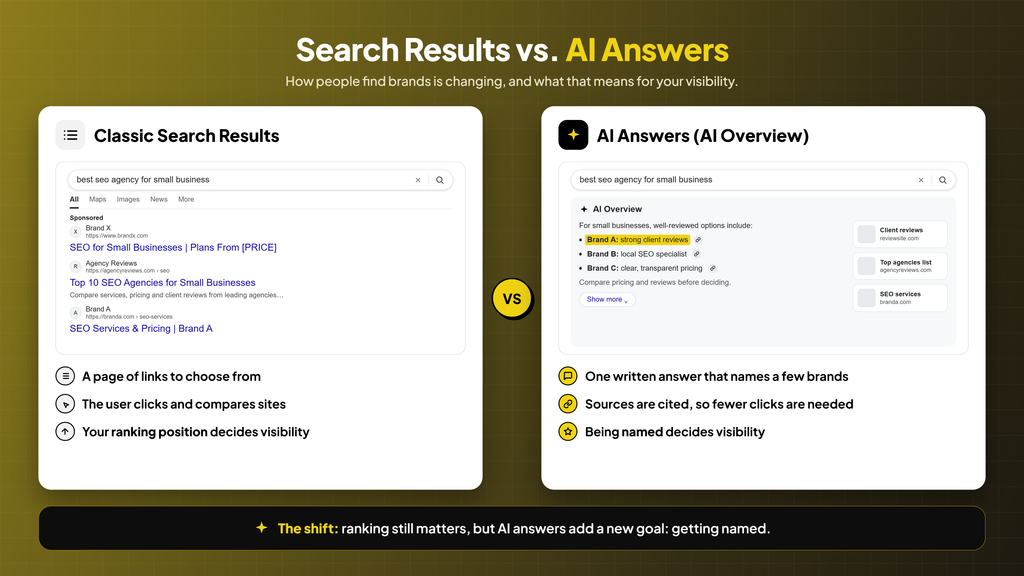
What Is Generative Engine Optimization (GEO)?
GEO, short for generative engine optimization, is how a brand goes from showing up in Google results to being suggested by AI. Also called AI SEO or answer engine optimization (AEO), it helps tools like ChatGPT, Google AI Overviews, AI Mode, Gemini, and Perplexity know your business well enough to name it.
SEO wins you a spot on a page of ten blue links. GEO puts your name inside the reply itself.
GEO doesn’t replace SEO. Google’s 2026 guide to AI features confirms that the same crawling, indexing, and quality systems still decide what appears. The difference is the prize: a mention or cited link inside an answer, not just a click.
Why AI Names Some Brands and Skips Others
AI tools rely on two sources:
- What the model already learned: articles, reviews, listings, and forum posts about your brand from its training data
- What it looks up live: web pages it pulls in the moment someone asks
When both tell the same clear story about your brand, AI recommends you. When the story is thin or mixed up, it names a competitor.
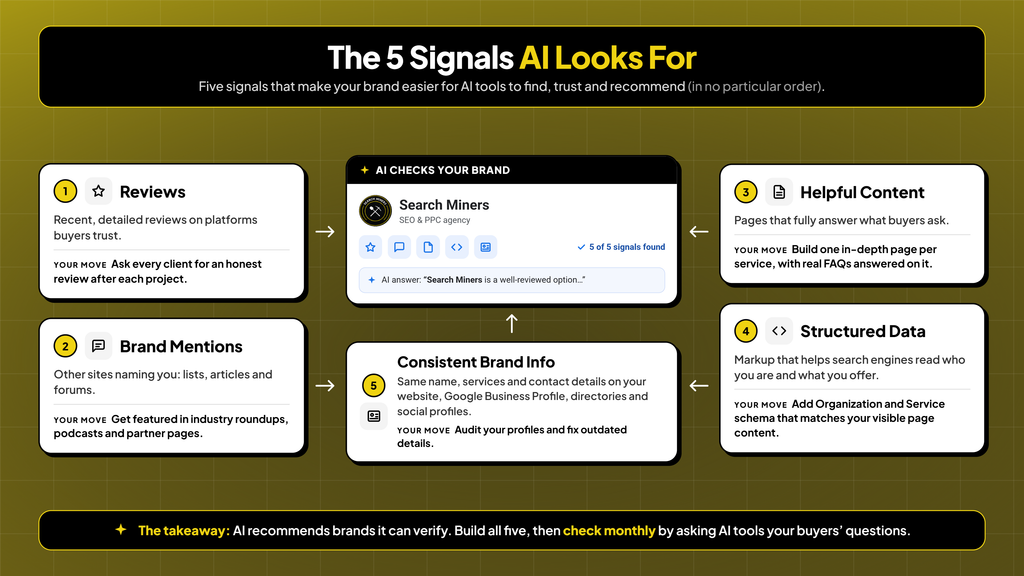
Key Strategies for GEO
- Get the SEO basics right. Google only uses pages it has crawled, indexed, and is allowed to show a snippet from. Keep pages fast, mobile-friendly, and well linked. AI can’t recommend what it can’t reach.
- Answer first, then explain. Make the first line under every heading a short, direct reply. AI tools often quote those lines word for word.
- Share what only you know. Real prices, timelines, service areas, original data, and client results. Google warns against “commodity” content that repeats what everyone else says.
- Earn mentions from others. Reviews, “best of” lists, local news and forum answers count for more than anything you say about yourself.
- Keep your facts the same everywhere. Pick one version of your business name, address, phone, and service list, then copy it exactly onto your website, Google Business Profile, social pages, and every directory listing. Back this up with Organization or LocalBusiness schema and sameAs links to your official profiles.

Is Your Website Ready for the AI Search Era?
Traditional SEO isn’t enough anymore. ChatGPT, Gemini, and AI Overview are changing how customers find businesses. Our GEO and semantic optimization strategies ensure you’re visible everywhere your customers are searching.
Stay ahead of the competition with cutting-edge optimization.
How AI Assistants Choose Which Brands to Name
A person types a prompt → the AI checks what it already knows and searches the web → it weighs the sources it finds → it returns a shortlist of around five brands.
Training Data
AI models learn from a huge snapshot of the internet. If your brand showed up often and clearly in that snapshot, the model already knows you. If not, you’re starting from zero.
Live Retrieval
Many AI tools now search the web in real time. ChatGPT Search, Perplexity, Gemini, and Google’s AI Mode all pull current pages before they answer. That means a new review, article or forum thread can help you, even if the model never saw it in training.
This allows for new reviews, articles, and forum threads to give you positive publicity without being seen by the model during training.
Since this live layer is where most businesses can make the quickest gains, it’s worth understanding how AI search visibility works before you start changing your content.
Platforms Differ
Each tool works a little differently. A BrightEdge study found ChatGPT names specific brands in 90% of its answers, while Google AI Overviews does so in 59% and points people to review sites more often.
As such, getting featured in one tool does not guarantee getting featured in all tools.
What 2026 Data Shows About AI Brand Recommendations
The short version is that AI recommendations are a winner-take-most game.
A CommerceV3 study ran over a million prompts between March and July 2026 across about 25,000 US ecommerce brands. It found that 78% of brands were never recommended in their category, while roughly five brands took 75% of all slots.
Murmuras looked at 10,541 real AI conversations from a smartphone panel. Half mentioned a brand, and 19% included an active recommendation, mostly while people were researching and comparing options.
So where do AI tools get their opinions? CommerceV3 tracked the sources behind the citations:
| Source type | Share of AI citations |
| Editorial reviews and articles | 34% |
| Reddit and forums | 22% |
| Marketplaces | 18% |
| Brand websites | 14% |
| Video | 7% |
| Other | 5% |
Notice how small that brand website slice is. AI mostly listens to what other people say about you.
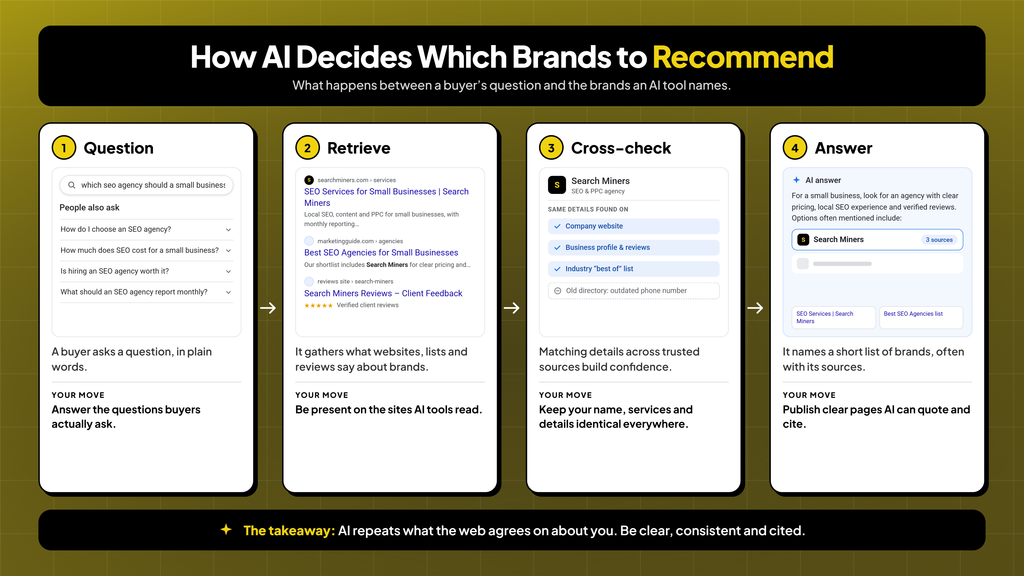
A 6-Step Plan to Get Recommended by AI
Getting recommended by AI comes down to six steps, done in order and repeated over time.
Step 1: Audit Your Current AI Mentions
Before making any changes, you need to know where you are. Come up with 10-20 questions that your customers will actually ask you, such as “best family dentist in Henderson” or “top CRM for small law firms.”
Ask these questions in ChatGPT, Gemini, Perplexity, and Google’s AI Overviews and take notes about what brands get mentioned, how they are described, and what websites are referenced by AI as the source.
Finally, make sure that you do not block any AI crawlers such as GPTBot or PerplexityBot in your robots.txt file.
If this feels like a lot, an SEO and GEO audit does all of it for you and shows exactly why competitors are getting named instead of you.
Step 2: Fix Your Entity and Schema
AI won’t recommend a brand it isn’t sure about. Start by writing a two-sentence description of your business: what you do, who you help and where.
What does your business do? Who do you help, and where? This same description should also have the same business name, address, and phone number for your website, Google Business Profile, LinkedIn, Facebook, and all directories you appear in.
Then add Organization or LocalBusiness schema to your homepage, and use the “sameAs” property to link to your social profiles.
Lastly, if your business brand is famous enough, get yourself added in Wikidata as well. Minor errors, such as an old address in Yelp or even an alternate business name on LinkedIn, may cause an AI to be confused if there’s more than one business in question.
Step 3: Rewrite Key Pages as Answers
Select five to ten of your most important webpages such as your homepage, main service pages, and main blog posts. Then, for each page, come up with questions that buyers may have about the topics you write about on each webpage and form those questions into headings.
For each heading, answer the questions posed in the opening sentence, using 40 to 60 words.
Then add the facts AI tools love to quote: your price range, the areas you serve, how long jobs take, years in business, and real results.
Step 4: Earn Reviews and Editorial Coverage
This is where things really change, because AI trusts what others say about you far more than what you say about yourself. Make review requests part of your routine. Send a short message with a review link within a day or two of finishing each job. Steady requests every month work much better than one big push a year.
As for the editorial coverage, use the sources found during the Step 1 audit, the articles with “best of…” and industry-related recommendations.
Step 5: Join Community Conversations
Search Reddit, Quora, and industry forums for questions about your service, especially threads that showed up as AI sources during your audit.
Answer them properly, the way you’d explain things to a friend, and only mention your business when it genuinely fits.
Use a real, named account and be open about who you are. Ten thoughtful answers over a few months build far more trust, with people and with AI, than fifty quick replies stuffed with links.
Moderators and users spot self-promotion quickly, and it can do more harm than good.
Step 6: Re-Test Every Month
Run the same prompts from Step 1 once a month and log the results in a simple spreadsheet. For each prompt and platform, record whether you appeared, where you ranked in the list, how you were described, and which sources were cited.
Over time, you will see what’s working. If a new review site starts showing up in AI answers, get listed there. If a competitor jumps ahead, look at which sources mention them, and you don’t.
AI answers shift often, so think of this as a monthly habit, much like checking your analytics.
How to Measure Your AI Recommendation Share
Build a list of 20 to 50 prompts your buyers would really type, like “best accountant for small businesses in Atlanta.” Run each prompt several times on every platform, because answers vary. CommerceV3 only counted a brand if it appeared in at least two out of five runs, which is a sensible rule to borrow.
Then track three things: how often you are recommended compared with competitors, whether the mentions are positive, and which sources the AI cites. Those sources tell you exactly where to focus next.
AI Recommendations for Local Businesses
Local searches work a little differently. When someone asks for “the best dentist in Las Vegas,” AI leans heavily on your Google Business Profile, your reviews, and local directories. Solid local SEO and a steady flow of genuine reviews do most of the heavy lifting here.
Become the Brand Others Vouch For
AI recommends the brands that other people trust and talk about. Build those signals one by one, measure your share every month, and keep going. No one can guarantee a spot in AI answers, but you can greatly improve your chances.
Ready to see where you stand? Book a free AI SEO consultation or start with an SEO and GEO audit from Search Miners.
AI Recommendation FAQs.
Why doesn’t ChatGPT mention my brand?
Usually because trusted sources don’t mention you enough, or describe you inconsistently. AI recommends brands that reviews, articles, and forums already vouch for.
Can you pay to be recommended by ChatGPT or Gemini?
No. There’s no paid placement in these answers, and research found ad spend didn’t help. You earn mentions through reviews, coverage and clear content.
How long does it take to appear in AI recommendations?
Live-search tools can reflect changes within weeks. Showing up in a model’s built-in knowledge takes longer. Most brands need several months of steady work.
Is GEO different from SEO?
They overlap a lot. SEO helps you rank in search results. GEO helps AI tools understand, trust and mention you. Strong SEO makes GEO much easier.
Can you pay to be recommended by ChatGPT or Gemini?
Not inside the answer itself. ChatGPT now shows some paid ads, but they’re labeled “Sponsored” and kept separate, and OpenAI says ads don’t change what ChatGPT recommends. You earn the actual recommendations through reviews, coverage and clear content.
About Patrick Michaels
Patrick Michaels
Patrick brings 10+ years of SEO expertise and 15+ years of professional writing experience to the Search Miners team. He specializes in creating clear, actionable content strategies that drive real business growth.