What Is Online Reputation Management (ORM)? Complete Guide 2026

Thanks for reading! I hope you enjoyed reading and learning more about digital marketing, SEO, and how to increase your visibility online.
Author: Patrick Michaels | Lead Content Strategist at Search Miners
Online reputation management (ORM) is the practice of shaping what people find when they search for your business, across Google results, review sites, social media, news coverage, and now AI-generated answers.
This is the uncomfortable part: your reputation gets built whether you participate or not.
Every review, every Reddit thread, every old news mention sits online and votes on your behalf. Customers read those votes before they ever talk to you. Most of them decide before you even know they exist.
That’s why ORM isn’t damage control for businesses in trouble. It’s the daily work of making sure the version of you that strangers find matches the version your best customers already know.
Search Miners, a Las Vegas SEO Company, treats reputation as part of search itself, because the first page of Google is your reputation for most people who look you up. What ranks there decides what they believe.
What Is Online Reputation Management?
Online reputation management is the ongoing process of monitoring, influencing, and improving how a business appears wherever its name appears online.
In practice, ORM covers four kinds of work:
- Monitoring, knowing what people say about you, where they say it, and catching problems while they’re still small.
- Responding, answering reviews, questions, and complaints in a way that shows future customers how you treat people.
- Building, earning fresh reviews, publishing content you control, and creating enough positive material that one bad mention can’t define you.
- Repairing, pushing down harmful results, correcting false information, and getting policy-violating content removed where platforms allow it.
ORM overlaps with SEO, PR, and customer service, but it isn’t any one of them. SEO decides whether people find you.
ORM decides what they think once they do.

Is Your Website Ready for the AI Search Era?
Traditional SEO isn’t enough anymore. ChatGPT, Gemini, and AI Overview are changing how customers find businesses. Our GEO and semantic optimization strategies ensure you’re visible everywhere your customers are searching.
Stay ahead of the competition with cutting-edge optimization.
Why Does Your Reputation Decide Who Buys From You?
Because for most customers, reviews and search results replace the conversation they’d otherwise have with you.
The numbers back that up:
A Harvard Business School study by economist Michael Luca found that a one-star increase in a restaurant’s Yelp rating leads to a 5 to 9 percent increase in revenue.
One star. That’s the gap between a slow month and a good one.
The large majority of consumers read reviews before choosing a local business, and most treat those reviews with the same weight as a personal recommendation.
And it works in reverse.
Research published by Davide Proserpio and Georgios Zervas found that hotels that started responding to reviews saw their ratings rise and received more reviews overall. Guests wrote more carefully when they knew management was reading.
People don’t just read your reputation. They watch how you handle it.
Where Does Your Online Reputation Actually Live?
Your reputation lives in six places, and most businesses only watch one or two of them.
1- Your Branded Search Results
Google your business name right now.
That first page, the reviews snippet, the “People Also Ask” box, the news results, is the single most-read document about your company. More people see it than your homepage.
2- Review Platforms
Google Business Profile carries the most weight for local businesses. Yelp, Trustpilot, TripAdvisor, and G2 matter depending on your industry.
Your rating, review count, and response rate all appear before anyone clicks.
3- Social Media
Not just your own posts. Tagged mentions, comments, and screenshots of your worst customer service day travel further than anything you publish yourself.
4- Forums and Communities
Reddit threads and niche forums rank surprisingly well for “[business name] reviews” and “[business name] scam” searches, and they stay ranked for years.
One honest thread from 2023 can outrank everything you published this quarter.
5- News and Press
Local coverage, industry mentions, and, yes, that one unflattering article all feed both Google and AI systems, building a picture of who you are.
6- AI-Generated Answers
This is the new one, and it changes the game. When someone asks ChatGPT, Perplexity, or Google’s AI Overview “is [your business] any good?”, the AI reads your reviews, your press, and those Reddit threads, then summarizes a verdict.
Your reputation is now relayed back to customers by a machine that reads everything.
How Do You Audit Your Own Reputation?
Start by seeing exactly what a stranger sees. It takes about an hour, and most business owners never do it.
Step 1: Search your name in an incognito window.
Google your business name, then add “[business name] reviews” and “[business name] complaints.” Incognito mode strips out your personalized results, so you see what a new customer sees.
Take a screenshot of the first page of each search.
Step 2: Score every result.
Mark each result on page one as positive, neutral, or negative.
Also, mark whether you control it (your site, your profiles) or someone else does (reviews, forums, press). The results you don’t control are where your risk lives.
Step 3: Check your ratings side by side.
Pull your average rating, review count, and most recent review date from Google, as well as any other platforms that matter in your industry.
A 4.6 rating with no new reviews since last year reads as abandoned rather than excellent.
Step 4: Ask the AI what it thinks of you.
Type “should I hire [your business]?” into ChatGPT and Perplexity. Read what comes back and note which sources it cites.
If the answer is wrong, thin, or built on one bad thread, you’ve just found your priority list.
Step 5: Set up ongoing monitoring.
Google Alerts for your business name is free and takes two minutes. Tools like Mention or Brand24 go deeper.
Either way, you want to hear about a bad review from your inbox, not from a customer who mentions it at the counter.
How Do You Handle Negative Reviews and Bad Press?
Respond fast, respond publicly, and fix the problem behind the complaint. In that order.
1- Reply to Every Negative Review Within 48 Hours
Your reply isn’t really for the angry reviewer. It’s for the next hundred people who read the exchange.
A calm response that acknowledges the problem, explains what you did about it, and offers to make it right does more for your reputation than five glowing reviews. A defensive reply does the opposite, and it stays public forever.
Keep it short: thank them, own what went wrong, state the fix, and take the details offline.
2- Request Removal Only When Content Breaks the Rules
Platforms will remove reviews that violate their policies: fake reviews from people who never bought from you, reviews containing hate speech or private information, and reviews clearly left for the wrong business.
They will not remove a review just because it’s harsh and true. Flag what genuinely violates policy, document your evidence, and let honest criticism stand next to your response.
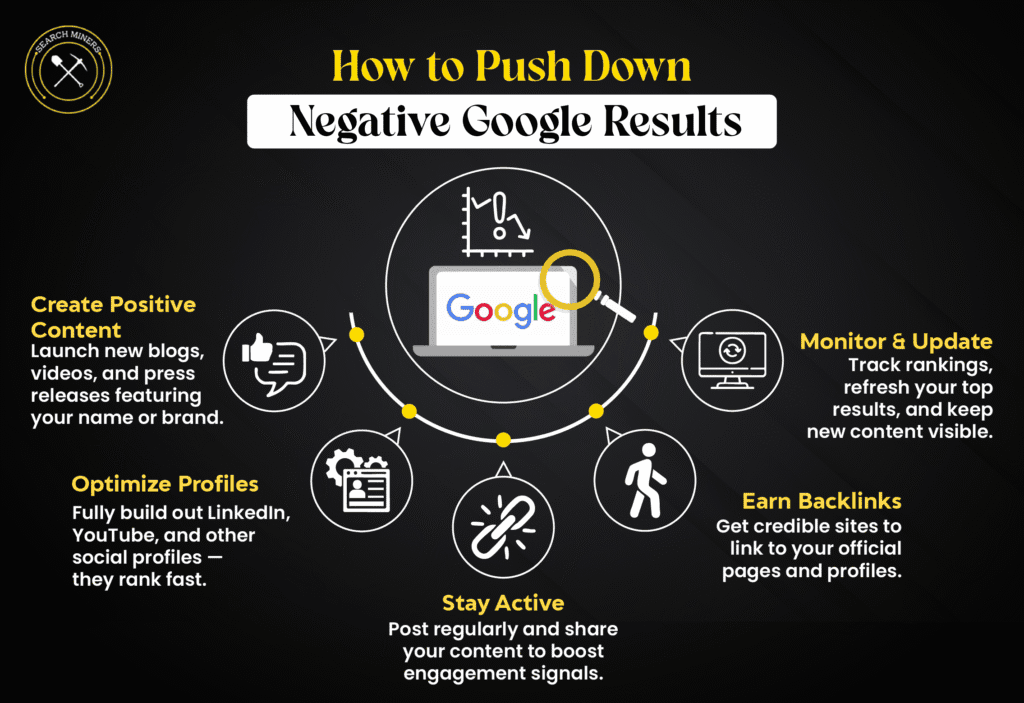
3- Outrank What You Can’t Remove
Some negative content is legal, accurate, and permanent. You don’t erase it. You surround it.
Publishing strong content on your own site, keeping active profiles on high-authority platforms, earning press coverage, and building out pages that naturally rank for your brand name all push weaker negative results down the page.
Every position you push a bad result down has real revenue attached to it.
This is where ORM becomes an SEO job, and where doing it well takes months, not days, because lasting reputation improvements come from consistent optimization rather than relying on SEO shortcuts.
4- Never Fight Fire With Fake
Buying reviews, review-swapping with other businesses, or having staff post as customers doesn’t just risk platform penalties.
In the UK and US, regulators now actively pursue fake review schemes.
One exposed fake review does more damage than ten honest negative ones.
How Do You Build a Reputation That Protects Itself?
The strongest ORM strategy is a steady supply of fresh, genuine proof that you’re good at what you do.
Build these habits and negative content loses its power to define you.
1- Ask for Reviews as Part of Your Process
Happy customers rarely review without a nudge; unhappy ones need no invitation. Some customers also ask whether they can leave an anonymous Google review, so it’s helpful to understand how Google’s review system actually works before requesting feedback.
Build the ask into your workflow: a follow-up email, a text after service, a QR code at checkout.
Steady beats sporadic; twelve reviews spread over a year signal more trust than twelve in one suspicious week.
2- Respond to Positive Reviews Too
A short, specific thank-you shows every reader that a human runs this business. It also encourages the next customer to write one because people write more when they know someone is reading.
3- Publish Content That Owns Your Branded Searches
An about page, team bios, case studies, and answers to the questions customers actually ask all give Google (and AI systems) accurate material to pull from.
That is exactly why semantic SEO helps businesses build content that reinforces both search visibility and brand trust.
Every strong page you publish is one more result on page one that you control.
4- Keep Your Profiles Alive
An unclaimed Google Business Profile, a LinkedIn page last touched in 2022, and outdated opening hours all whisper the same thing: nobody’s home. Complete, current, and consistent profiles across platforms confirm to both people and AI systems that your business is active and legitimate.
5- Earn Mentions You Don’t Control
Third-party validation, press features, industry roundups, genuine community participation carry more weight than anything you say about yourself. AI systems in particular lean heavily on independent sources when deciding how to describe a brand.
5 Common Mistakes That Wreck Online Reputations
Most reputation damage is self-inflicted and usually stems from one of these habits.
1- Ignoring Reviews Until There’s a Crisis
A business that only engages with its reviews after a one-star pile-up looks reactive and rattled.
The businesses that weather bad reviews best are the ones with a long, visible history of calm responses before anything went wrong.
2- Arguing With Customers in Public
Winning the argument loses the audience. Every heated reply gets read by future customers who weren’t there, don’t know the context, and only see how you behave under pressure.
3- Letting Profiles Go Stale
Dead profiles create a vacuum, and vacuums get filled by whatever else exists. Old complaints, outdated info, competitor content. If you don’t supply the current story, the internet tells the old one.
4- Trying to Delete Everything Negative
Aggressive takedown attempts on legitimate criticism often backfire spectacularly; the Streisand effect is named after exactly this.
A page-one of nothing but perfection also reads as suspicious.
A 4.7 with thoughtful responses to its critics converts better than a flawless 5.0.
5- Treating ORM as a One-Time Project
Reputation is a stream, not a statue. A six-week cleanup with no ongoing system just resets the clock until the next problem. Monitoring, review generation, and content publishing must continue to run, or the gains will quietly erode.
How Do You Measure Your Reputation Over Time?
Track four things monthly, and you will see problems forming before they hit revenue.
Track your branded page one.
Count how many page-one results for your business name are positive and under your control.
Watch that number month over month. It’s the clearest single measure of ORM progress.
Track ratings, volume, and velocity.
Log your average rating, total review count, and the number of new reviews that arrived that month for each platform.
Velocity, the pace of new reviews, is the early-warning metric most businesses miss.
Track sentiment, not just stars.
Read what people actually praise and complain about. If three reviews in a month mention slow replies, that’s an operations problem showing up as a reputation problem.
Fix the cause, not just the symptom.
Re-run your AI checks.
Once a month, ask ChatGPT, Perplexity, and Google the same questions about your business and log how the answers change.
When the AI’s summary of you improves, everything upstream is working.
How Does Search Miners Manage Online Reputation for Clients?
Search Miners treats your reputation and search presence as a single system because your customers experience them as one.
Our online reputation management services start with a full audit of what your customers, and now AI systems, actually find when they look you up.
From there, we build the response systems, review generation, content, and suppression work that put you back in control of your own first page.
Book a reputation audit with Search Miners or call us at (760) 760-7170 and see exactly what your name says about you before your next customer does.
People Also Ask
Is online reputation management the same as PR?
No. PR pushes your story out through media coverage and announcements. ORM manages what already exists about you online, reviews, search results, forum threads, and shapes what people find when they come looking. The two work best together, but ORM continues to work long after a press cycle ends.
Can negative reviews be removed from Google?
Only when they violate Google’s policies, are fake reviews, spam, hate speech, off-topic content, or reviews left for the wrong business. Honest negative reviews stay up. The reliable play is responding well publicly and building enough fresh positive material that one bad review stops mattering.
How long does online reputation repair take?
Review responses and profile fixes show results within weeks. Pushing negative search results down page one typically takes three to six months of consistent content and SEO work, and stubborn high-authority results can take longer. Anyone promising overnight removal is selling something that doesn’t exist.
Does my small business really need ORM?
Small businesses arguably need it most. With fewer total reviews, each one moves your average further, and a single negative page-one result takes up a bigger share of what customers find. Consistent small habits- asking for reviews, replying to everything, keeping profiles current- cover most of what a small business needs.
About Patrick Michaels
Patrick Michaels
Patrick brings 10+ years of SEO expertise and 15+ years of professional writing experience to the Search Miners team. He specializes in creating clear, actionable content strategies that drive real business growth.