3 Phases of Local SEO for Small Businesses That Work in 2026

Thanks for reading! I hope you enjoyed reading and learning more about digital marketing, SEO, and how to increase your visibility online.
Author: Patrick Michaels | Lead Content Strategist at Search Miners
Local SEO in 2026 has changed.
Google Business Profiles and citations alone are not enough. Small businesses need to show up in Google Search, Google Maps, AI Overviews, and AI platforms like ChatGPT and Perplexity.
Many businesses miss out because of incomplete profiles, inconsistent business details, weak local citations, and limited reviews. As AI-powered search changes how people find local services, ranking in the Google Maps Pack alone is no longer enough.
At Search Miners, we help small businesses grow through data-driven local SEO services designed for today’s search landscape.
What Is Local SEO?
Local SEO helps your business connect with nearby customers at the exact moment they need your products or services.
Whether someone searches for “Las Vegas plumber” or “coffee shop near me,” a strong local SEO strategy increases your chances of being seen first.
Unlike traditional SEO, which aims to attract visitors from a broad audience, local SEO focuses on reaching people within your service area who are actively looking for a nearby business.
In 2026, local visibility goes well beyond appearing on Google Maps. Businesses need a presence across several digital touchpoints, including:
- Google Business Profile and the Local 3-Pack
- Google AI Overviews for location-based searches
- Organic search results targeting local keywords
- Review sites such as Google, Yelp, and industry-specific directories
- AI search platforms like ChatGPT and Perplexity that recommend local businesses
- Local directories, news sites, and community mentions that build credibility and trust
The biggest advantage of local SEO is its focus on intent.
People searching for local businesses are often ready to make a purchase, book a service, or visit a location, making them far more likely to become customers.
BrightLocal’s Local Search Report found that 76% of smartphone users who search for a nearby business make an in-person visit within a day of their search.
They want to call, book an appointment, get a quote, or visit you. That makes every visitor valuable.

Is Your Website Ready for the AI Search Era?
Traditional SEO isn’t enough anymore. ChatGPT, Gemini, and AI Overview are changing how customers find businesses. Our GEO and semantic optimization strategies ensure you’re visible everywhere your customers are searching.
Stay ahead of the competition with cutting-edge optimization.
How Does Local Search Work in 2026?
Understanding the mechanics changes where a small business should focus.
1- Google Business Profile and the 3-Pack
Google’s 3-Pack (three business listings that appear on Maps and search results) is still the most direct source of foot traffic and calls for local businesses.
Google evaluates local rankings using three primary factors:
- Relevance: How closely your business matches what the user is searching for.
Distance: How near your business is to the searcher’s location.
Prominence: How established and trustworthy your business appears within the local community.
Your business category, services, and profile information influence relevance.
Distance is based on your physical location relative to the searcher.
Prominence grows through positive customer reviews, accurate local citations, quality backlinks, and mentions of your business across the web.
2- Google AI Overviews for Local Queries
Google now answers some local searches with an AI Overview instead of the traditional 3-Pack.
When an AI Overview appears, the 3-Pack drops below the fold. This is a real loss of traffic for businesses that aren’t cited in that Overview.
Unlike traditional Google organic results, which pull heavily from the same businesses in the 3-Pack, Google’s AI Overviews also pull from review sites, local media, and third-party recommendations.
A business can have a strong local ranking and still be skipped entirely by the AI Overview.
That’s because the AI cites a competitor’s Yelp review, a local magazine recommendation, or a directory listing instead.
Understanding semantic SEO and how search engines interpret your content helps you get cited in these AI answers.
3- ChatGPT and Perplexity for Local Recommendations
ChatGPT and Perplexity have added local business recommendations when search is enabled.
A user asking Perplexity “best accounting firms in Las Vegas” gets a response with business recommendations, links to Google Business Profiles, and sometimes pricing or service details.
These systems pull from:
- Google Business Profile data
- Review sites (Google, Yelp, specialized platforms)
- Business websites and publicly available information
- Local media and directory listings
- Third-party trust signals (ratings, mentions, citations)
Unlike Google’s algorithm, they don’t require a traditional #1 ranking to be included.
A business with a strong reputation on review sites but a weaker organic ranking can still get recommended.
The Local SEO Strategy: What Actually Works for Small Businesses?
Knowing the factors is one thing.
Actually implementing them sustainably is another challenge when you are bootstrapping.
This is the sequence that works:
Phase 1: Foundation (Months 1-2)
1. Claim and Complete Your Google Business Profile
If you don’t have one, claim it. If you do, audit it completely.
Every field is important:
- Business name (exact legal name)
- Address (real physical location, not a mailbox)
- Phone number (local number preferred)
- Website URL
- Hours (including holidays and special closings)
- Service area (if you serve a defined region)
- Business category (pick the most specific match)
- Description (750 characters, answer the customer question “why should I choose this business?”)
- All available attributes (payment methods, accessibility, parking, languages spoken, etc.)
- 10-15 high-quality photos (storefront, team, products/services in action)
- Service list with pricing (if applicable)
Most businesses leave 40% of this blank.
Filling it in completely takes 3-4 hours and typically results in 10-20% more visibility immediately.
2. Get 10-15 First Reviews
If you have zero reviews, this is your priority.
Reviews are proof to Google (and to potential customers) that your business exists and serves customers.
You don’t need 200 reviews. You need reviews that happen this month.
This is how you can ask for reviews without being pushy:
- After a completed project or service, send a follow-up email with a direct link to your Google Business Profile review section
- In-person businesses can ask at checkout: “Would you mind leaving us a quick review on Google?”
- For service businesses, send a text message link the day after service is completed
- Don’t incentivize reviews for Google (that violates their policy); incentivize engagement (offer a discount on next purchase for any feedback)
Expect a 5-10% response rate. If you serve 100 customers a month and ask 50 for a review, you will get 3-5.
Phase 2: Momentum (Months 2-4)
3. Get Listed on Key Directories
Focus on the directories where your potential customers actually look:
- All businesses: Google Business Profile, Yelp, Apple Maps, Bing Places
- Local services: Chamber of Commerce, Better Business Bureau, local business association
- By industry: Avvo (lawyers), Angie’s List (contractors), Healthgrades (medical), Capterra (software), etc.
Accuracy matters more than coverage. Get listed correctly on 10 key directories rather than half-correctly on 50.
4. Start Building Local Backlinks
Get backlinks from websites in your area.
Find 5-10 local opportunities per month.
Pitch local news outlets for “businesses to watch” columns. Join your Chamber of Commerce and write an article.
Find industry lists like “Top 10 Plumbers in Las Vegas” and ask to be included. Sponsor a local event to earn a mention and link. Guest post on local blogs.
One good local backlink per month builds your rankings steadily over time.
5. Build a Review Asking System
Don’t ask for reviews randomly. Build it into what you already do.
- Service businesses: Add a review request to invoices, text messages, and follow-up emails.
- Retail: Print QR codes for your Google review page and put them on receipts or at checkout.
- Online services: Send a templated email with a review link when a project ends.
Aim for 3-5 new reviews each month. The key is making the ask automatic, not something you remember to do.
Research from Harvard Business School found that independent restaurants can see their revenue grow by 5% to 9% after improving their Yelp rating by just one star.
Phase 3: Scaling (Month 4+)
6. Create Local Landing Pages on Your Website
If you serve multiple locations, build one page for each location. Use local keywords like “Las Vegas SEO Company” instead of just “SEO Company.”
Add your address, phone, and hours.
Include local testimonials and case studies. Add local schema markup, so Google knows the page is about that specific location.
Include a call-to-action and contact form.
Businesses that create location-specific pages get 20-40% more local traffic than those using a single generic page.
Make sure your mobile experience is optimized too. Use our mobile SEO checklist to ensure every location page performs on phones and tablets
7. Generate Local Content Opportunities
Once you have the foundation in place, create content that earns local links and citations.
Write local case studies and success stories. Blog about local industry trends. Contribute expert commentary to local media.
Sponsor local events to earn coverage. Participate in community events and charitable work.
This content gets you mentioned on local websites, which builds your authority and rankings.
8. Monitor and Respond to Reviews
Set aside 30 minutes per week to:
- Respond to all new reviews (positive and negative)
- Thank customers for positive reviews
- Address concerns in negative reviews professionally
- Flag fake or inappropriate reviews for removal
Businesses that actively respond to reviews see a 15-25% improvement in new review generation (people are more likely to leave reviews if they see the business engages with them).
8 Common Local SEO Mistakes That Kill Rankings
Small businesses often make the same mistakes over and over. Avoiding these saves months of lost opportunity.
1. Incomplete or Outdated Google Business Profile
A GBP with missing information, outdated hours, or old photos signals to Google that the business isn’t actively managed. Google’s algorithm deprioritizes profiles it thinks might be inactive.
Do a full audit quarterly.
Update hours if they have changed, refresh photos every 6 months, and keep the description up to date.
2. Inconsistent Business Information Across the Web
Your business name, address, or phone number spelled differently on different websites (your site vs. Yelp vs. directory listings) tells Google the listings are unreliable. Rankings drop.
Audit all your directory listings.
Make sure the NAP (name, address, phone) is identical across all listings. If you find inconsistencies, update them immediately.
3. Ignoring Negative Reviews
A business with a 4.2-star rating that responds professionally to every negative review ranks higher than a business with a 4.8-star rating that ignores complaints.
Set a weekly reminder to check for and respond to all new reviews. Negative reviews, answered, actually build trust.
4. Getting Reviews From Competitors or Family
Google filters out reviews that look fake (same IP address, reviews from people with no other review history, obvious promotional language). Bulk review buying or trading reviews with competitors backfires.
Ask your real customers through legitimate channels (email, text, or in person).
Focus on volume from real, organic sources.
5. Blocking AI Crawlers
Some businesses block GPTBot, PerplexityBot, or Google-Extended in their robots.txt file, thinking they’re protecting their content.
Instead, they are opting out of being cited in AI Overviews and AI recommendations.
Allow all AI crawlers. If you want to appear in ChatGPT, Perplexity, or Google AI Overviews when customers search, don’t block them.
6. Poor Website Information Architecture
A local business with a website but vague service descriptions, hidden pricing, or unclear location information gets skipped by AI systems when evaluating local recommendations.
Make sure your website clearly shows your location (full address), hours, services/products offered, pricing (or price ranges), and contact information. This isn’t just good for SEO; it’s good for customers.
7. Neglecting Review Site Optimization
Google isn’t the only platform customers use to find local businesses.
Yelp, industry-specific review sites, and Google Reviews generate 40-60% of local search traffic for most businesses.
A weak presence on these platforms means missed opportunities.
Audit your presence on Yelp, industry-specific sites (Avvo, Healthgrades, Capterra, etc.), and any platform where your customers leave reviews. Optimize each profile as much as you’d optimize your GBP.
8. Ignoring AI Overviews
A business that optimizes for traditional local rankings but completely ignores AI Overviews is leaving revenue on the table.
Once every month, search your top local keywords on Google, ChatGPT, and Perplexity.
Check if you are appearing in AI answers. If competitors are cited and you’re not, audit your website structure, review your presence, and verify the accuracy of your business information.
How Search Miners Builds Local SEO for Small Businesses?
Search Miners treats local SEO as a long-term strategy, not a quick fix.
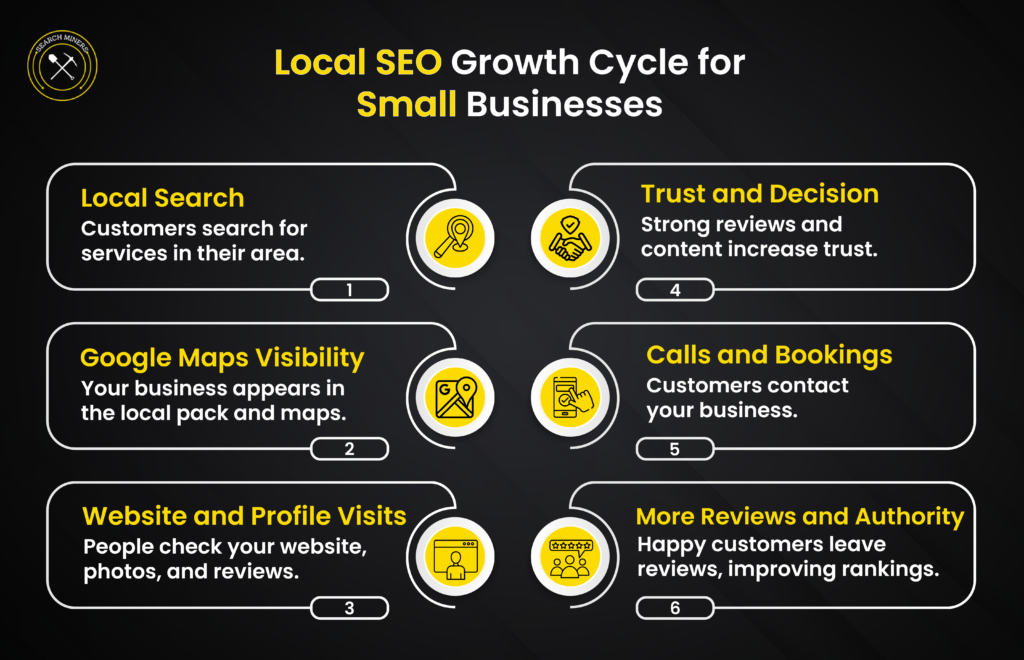
We start with a foundation audit:
Where do you rank today?
What’s your review volume and rating?
Where are you listed (or missing)?
How does your website compare to competitors?
Then we build a sequence:
- Optimize your Google Business Profile using your top customer pain points and success stories to write a profile description that converts
- Build a review-generation system for your business type (retail, service, online, etc.).
- Unify your local citations, ensuring consistent NAP across all key directories
- Create location-based website content if you serve multiple areas, building distinct landing pages
- Monitor and maintain monthly tracking of rankings, reviews, and AI visibility
Both Google and AI search matter. You need to show up in both places.
Most clients see 20-40% more calls and leads within 3 months, and 50%+ improvement within 6 months.
Book a Local SEO Audit with Search Miners to see where your business stands today, what’s working, what’s not, and exactly what it would take to own your local market.
About Patrick Michaels
Patrick Michaels
Patrick brings 10+ years of SEO expertise and 15+ years of professional writing experience to the Search Miners team. He specializes in creating clear, actionable content strategies that drive real business growth.