
7 Ways to Adapt Your SEO Budget for AI Search in 2026

Thanks for reading! I hope you enjoyed reading and learning more about digital marketing, SEO, and how to increase your visibility online.
Author: Patrick Michaels | Lead Content Strategist at Search Miners
To adapt your SEO budget for AI search, shift your spending into semantic SEO, entity optimization, technical SEO, and GEO. This helps your business rank on Google, appear in AI-generated answers, and generate more qualified leads.
Find Out How Much SEO Really Costs
Get a personalized SEO cost estimate based on your goals, competition, and target market.
Most businesses still spend on SEO using outdated tactics like heavy backlink building and thin, keyword-focused content, even as search has changed.
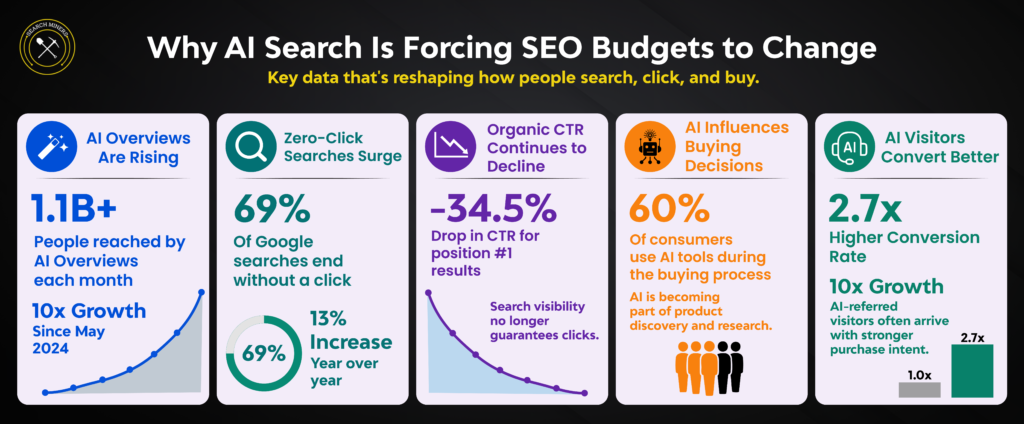
Today, users find answers through Google AI Overviews, ChatGPT, Perplexity, and voice search, often without clicking websites.
At Search Miners, we help Las Vegas businesses grow through semantic SEO, GEO, and local SEO strategies built for Google and AI search.
First, Audit Where Your SEO Budget Is Going Right Now
Before making changes, understand exactly where your SEO budget is being spent. Many businesses pay for SEO without knowing how the money is divided among backlinks, content, technical fixes, and local optimization.
Ask yourself:
- How much goes into backlinks each month, and are they improving rankings or just inflating reports?
- How much is spent on content, and is it valuable or simply posted for consistency?
- Are you putting enough into technical SEO, like indexing, site structure, and page speed?
This review exposes unnecessary spending, and in most cases, there is plenty to cut.

Is Your Website Ready for the AI Search Era?
Traditional SEO isn’t enough anymore. ChatGPT, Gemini, and AI Overview are changing how customers find businesses. Our GEO and semantic optimization strategies ensure you’re visible everywhere your customers are searching.
Stay ahead of the competition with cutting-edge optimization.
1. Cut Back on Low-Value Link Building and Focus on Authority Signals
Many businesses still spend a large chunk of their SEO budget buying guest posts, directory submissions, and low-authority placements simply to increase Domain Authority or URL Rating.
The problem is that AI-powered search engines prioritize trust, context, and relevance over raw link volume.
Understanding the difference between inbound links and backlinks can also help businesses focus on stronger authority signals instead of chasing low-value link volume.
Instead of spending heavily on volume-based link building, shift part of that budget into digital PR, branded mentions, and content that naturally earns links.
This builds stronger authority over time.
2. Increase Spending on Semantic SEO Content and Topic Clusters
Semantic SEO means building content around complete topics instead of isolated keywords.
Search engines rely on natural language processing to understand how words, phrases, and topics connect. This means your content should address the topic completely, not just touch the surface.
For example, if your main keyword is “SEO budget,” related semantic terms should include organic traffic, SEO costs, return on investment, technical SEO, keyword research, search intent, local SEO, AI search optimization, content marketing, and conversion tracking.
Instead of publishing one article on SEO budgets, build a topic cluster.
That could include pages like “how much does SEO cost,” “SEO vs PPC costs,” “how to measure SEO ROI,” and “SEO budgeting for small businesses.”
3. Allocate Budget for GEO to Improve AI Search Visibility
Generative Engine Optimization (GEO) is now an important part of SEO because it helps your content appear in AI-generated answers.
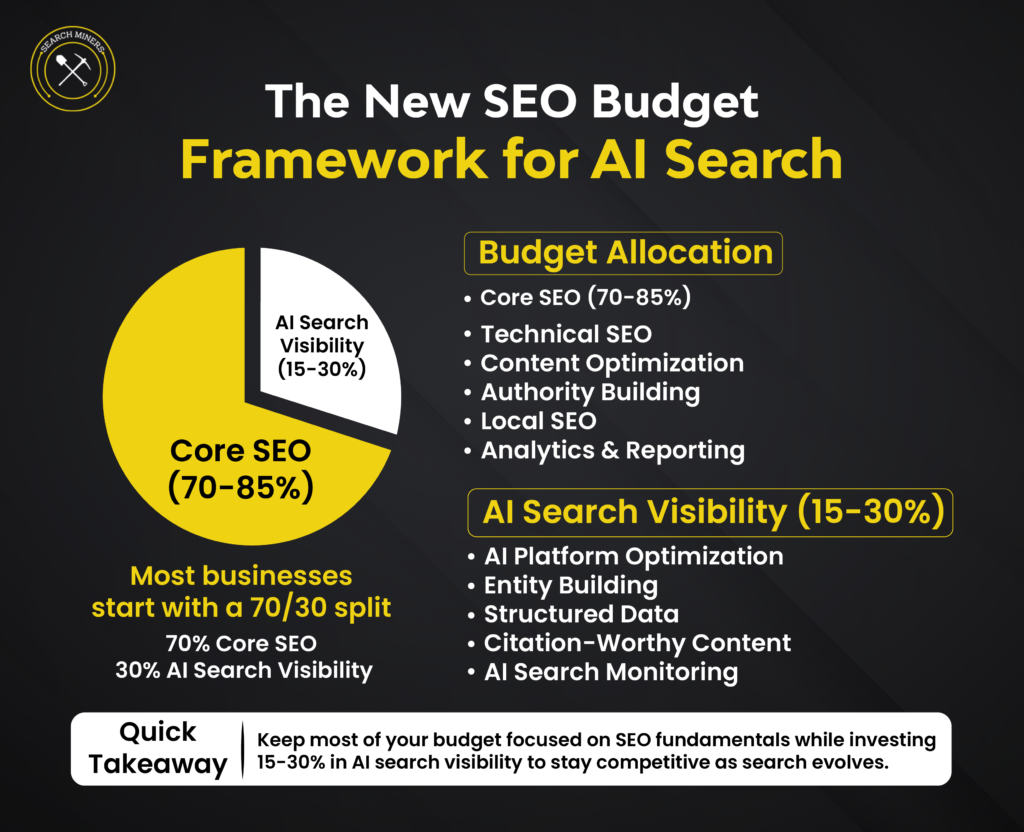
Regular SEO is about ranking higher in search results. GEO is about making your content easy for AI tools to understand and use in their responses.
For example, if someone asks an AI tool, “How much should a small business spend on SEO?” it will search for content that gives simple, clear, and direct answers.
Content with clear headings, quick explanations, FAQs, and well-organized sections is more likely to be picked.
Spending on GEO means improving how your content is written and structured so AI can find it, understand it, and mention it. It is a smart way to grow your visibility in AI search.
4. Spend More on Entity SEO to Strengthen Brand Recognition
Entity SEO helps search engines connect your business with your services, location, and expertise.
Google’s Knowledge Graph and AI search systems rely on entities to understand who you are and what you do.
For example, if Search Miners is connected to “Las Vegas SEO company,” “semantic SEO,” “AI optimization,” and “Google rankings,” it builds stronger trust signals than a website with no clear entity connections.
To improve entity SEO, spend budget on consistent NAP (Name, Address, Phone) across directories, branded citations, author profiles, company schema, and service pages tied to your location.
These help search engines build a stronger picture of your business.
Stronger entity recognition often leads to better visibility in both local search and AI answers.
5. Increase Technical SEO Budget for Better Crawlability and Indexing
Technical SEO is the system behind everything else.
Without it, your content may never reach its full ranking potential. Search engines and AI crawlers need clean site architecture, fast-loading pages, and clear internal pathways.
Following a strong mobile SEO checklist can help improve user experience, page speed, and Core Web Vitals.
For example, if your service pages are buried deep without internal links, Google may struggle to understand their importance.
If your site loads slowly or has a broken schema, AI tools may skip over key information.
A strong technical budget should cover Core Web Vitals, crawl budget optimization, internal linking, XML sitemaps, schema markup, mobile performance, and page indexing.
This makes your website easier to understand and improves overall visibility.
6. Keep a Strong Budget for Local SEO and Local Search Signals
Local SEO remains one of the strongest investments for service-based businesses. AI tools still rely heavily on local trust signals when recommending businesses.
For example, if someone asks “best SEO company in Las Vegas,” Google and AI systems often look at Google Business Profile, reviews, local citations, and city-specific landing pages.
Your budget should support review generation, local business schema, map pack optimization, and service-area pages.
These elements help strengthen location relevance and improve local search performance.
AI search does not replace local SEO. It makes the local authority even more important.
7. Measure AI Visibility, Brand Mentions, and Lead Quality
The way businesses measure SEO success needs to evolve. Rankings and traffic still matter, but they are no longer enough.
Today, businesses should track AI citations, branded searches, SERP visibility, click-through rates, conversion rates, and lead quality.
For example, if your content is being mentioned in Perplexity or Google AI Overviews, that is a powerful trust signal even if rankings stay the same.
A lower-ranking page that drives better leads is often more valuable than a top-ranking page with low traffic. The goal is no longer just visibility. The goal is qualified visibility.
That is where modern SEO budgeting needs to focus.
Recommended SEO Budget Breakdown for AI Search
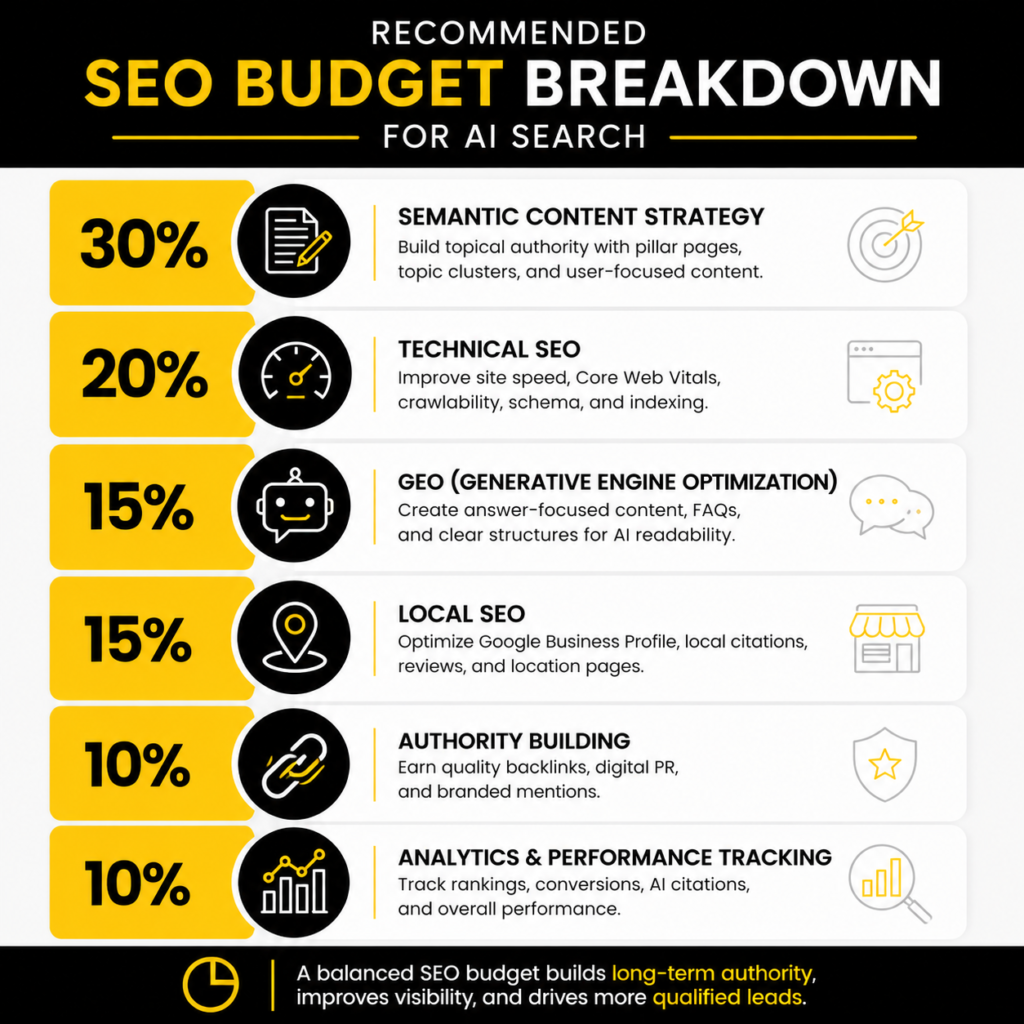
Instead of putting too much budget into one area like backlinks, we recommend spreading your investment across the systems that build long-term authority, improve search visibility, and increase qualified leads.
30% for Semantic Content Strategy
We recommend making semantic content your biggest investment because it builds topical authority.
This includes pillar pages, topic clusters, service pages, and informational content built around search intent, semantic relevance, and user questions.
For example, instead of writing one page on “SEO services,” you should support it with related content like SEO pricing, SEO audits, local SEO strategy, and AI SEO optimization.
20% for Technical SEO
We recommend keeping a strong technical SEO budget because it supports everything else.
This covers site speed improvements, Core Web Vitals, internal linking, crawl budget optimization, schema markup, and indexing fixes.
A fast, clean, and crawlable site makes it easier for Google and AI systems to process your content.
15% for GEO (Generative Engine Optimization)
We recommend allocating part of your budget to GEO, as AI search visibility is growing rapidly.
This includes building answer-focused content, FAQs, concise definitions, and clear content structures designed for AI readability.
This improves your chances of being referenced in tools like ChatGPT, Google AI Overviews, and Perplexity.
15% for Local SEO
For local businesses, we strongly recommend keeping local SEO as a core part of the budget. This includes Google Business Profile optimization, local citations, city landing pages, review generation, and map pack optimization.
These local trust signals help both Google and AI systems understand your relevance in your market.
10% for Authority Building
We recommend focusing this part of the budget on digital PR, branded mentions, niche placements, and high-quality backlinks instead of low-value bulk link building.
The goal here is to build real authority, not just increase link count.
10% for Analytics and Performance Tracking
We recommend keeping part of the budget for analytics so you can measure what is actually working.
This includes Google Analytics, Search Console, rank tracking, conversion tracking, and AI citation monitoring.
Without proper tracking, it becomes harder to see what is driving leads and what needs improvement.
Is Your Website Ready for the AI Search Era?
Traditional SEO isn’t enough anymore. ChatGPT, Gemini, and AI Overview are changing how customers find businesses. Our GEO and semantic optimization strategies ensure you’re visible everywhere your customers are searching.
Stay ahead of the competition with cutting-edge optimization.
Final Note!
Adapting your SEO budget for AI search is not about spending more. It is about spending smarter. Businesses winning today invest in semantic SEO, entity optimization, technical SEO, GEO, and local trust signals to improve rankings, AI visibility, and lead quality.
Book a free consultation with Search Miners and get an SEO audit to improve your Google rankings, AI search visibility, and lead generation.
Rank Higher in Las Vegas Search Results
Get exclusive SEO insights, digital marketing strategies, and growth tips delivered straight to your inbox. Join business owners who are already using our expert advice to attract more customers and grow their revenue.
People Also Ask
What is the best way to adapt an SEO budget for AI search?
A smart move is to spend less on old-style link building and put more money into better content, website improvements, GEO, and building strong topic connections. This helps your site perform better in search and AI tools.
Does AI search make backlinks less important?
Yes, backlinks still play a role, but having strong and trusted links is much more important than collecting large numbers of weak ones. AI looks more at credibility and relevance.
Why is semantic SEO important for AI search?
Semantic SEO helps search engines understand your topic in depth by connecting related ideas and terms. This makes your content more complete and trustworthy.
Should local businesses change their SEO budgets too?
Yes, local brands should focus more on local search, helpful content, and accurate site data to stay visible in both search engines and AI-driven results.
About Patrick Michaels
Patrick Michaels
Patrick brings 10+ years of SEO expertise and 15+ years of professional writing experience to the Search Miners team. He specializes in creating clear, actionable content strategies that drive real business growth.


