
Semantic SEO: How to Create Topical Authority in 2026?

Thanks for reading! I hope you enjoyed reading and learning more about digital marketing, SEO, and how to increase your visibility online.
Author: Patrick Michaels | Lead Content Strategist at Search Miners
Google no longer reads your page for keywords. It reads it for meaning, and that shift is why semantic SEO decides who ranks and who doesn’t.
Building topical authority means picking one core topic, mapping every subtopic a reader might eventually ask about, and covering it fully across a connected cluster of pages. Write for meaning, not exact phrases, and let real entities and context do the work.
Do this consistently, and Google stops seeing isolated pages. It starts seeing a site that actually knows the subject.
Search Miners, the #1 Las Vegas SEO Company for Google & AI, builds every content strategy around this idea, because guessing at keywords stopped working years ago.
What Is Semantic SEO?
Semantic SEO means optimizing content around meaning and intent instead of exact keywords.
Instead of writing one page for “best running shoes” and a separate page for “top running shoes,” semantic SEO treats them as the same idea and builds a single strong page that fully answers the question behind both phrases.
Google’s algorithms now understand synonyms, related concepts, and the relationships between ideas.
A page doesn’t need to repeat a keyword to rank for it. It needs to demonstrate understanding of the subject.
A bakery once made three pages: “birthday cakes near me,” “custom cakes for birthdays,” and “birthday cake bakery.” Each page repeated its own phrase and said little else. None of them ranked well.
They combined all three into a single page on flavors, custom designs, and delivery, written the way a baker would actually explain it.
That one page ranked for all three phrases, plus many more nobody had even targeted. The keywords didn’t change. The meaning did.

Is Your Website Ready for the AI Search Era?
Traditional SEO isn’t enough anymore. ChatGPT, Gemini, and AI Overview are changing how customers find businesses. Our GEO and semantic optimization strategies ensure you’re visible everywhere your customers are searching.
Stay ahead of the competition with cutting-edge optimization.
How Semantic SEO Differs from Traditional Keyword SEO?
Traditional SEO treated keywords as isolated targets.
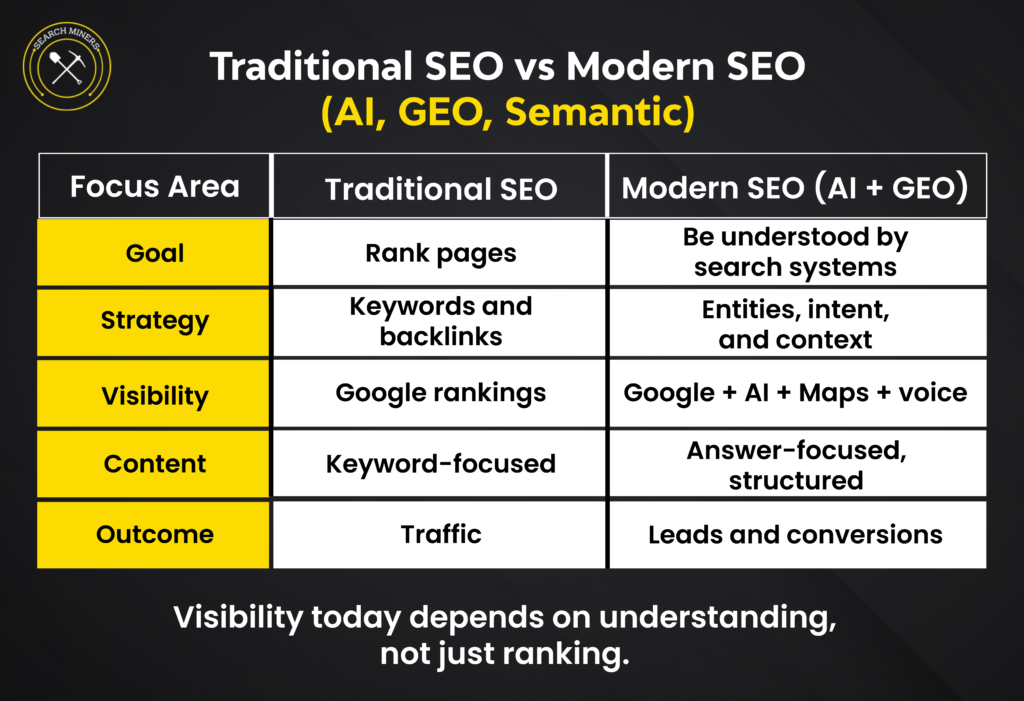
Writers repeated exact phrases, built separate pages for slight keyword variations, and measured success by rankings for individual terms.
Semantic SEO treats a keyword as a signal pointing to a broader topic.
| Traditional Keyword SEO | Semantic SEO | |
| Focus | Exact keyword phrases | Meaning and intent behind the phrase |
| Page strategy | Separate page for each keyword variation | One complete page covering the whole topic |
| Success measure | Ranking for individual terms | Ranking for the topic as a whole |
| Content approach | Repeat the exact phrase often | Cover related ideas naturally |
| Example | Separate pages for “marathon training” and “how to train for a marathon” | One page covering pacing, nutrition, injury prevention, and race-day strategy |
What Is Topical Authority?
Topical authority is the trust a search engine places in a website because that site consistently, accurately, and thoroughly covers a subject.
A site with topical authority on dog nutrition doesn’t just rank one article. It ranks dozens of pages across that subject, because Google recognizes the entire site as a reliable source on the topic.
Authority builds page by page.
Each new piece of content that fits into a topic cluster adds evidence that the site knows what it’s talking about.
Over time, new content on the same subject starts ranking faster because the foundation already exists.
A pet supply site once published a single, well-written article on raw dog food diets. It ranked decently but remained isolated, since nothing else on the site addressed the topic.
Over the next year, they added articles on portion sizing, food allergies, breed-specific needs, and transitioning puppies to solid food.
None of these were huge individual efforts, but together they built a full picture of canine nutrition.
By the tenth article, new posts on the same subject began ranking within weeks rather than months.
Google no longer had to figure out if the site knew the topic. The previous articles had already proven it.
Why Is Semantic SEO Important More in 2026?
Search has changed faster in the last few years than in the decade before it; semantic understanding sits at the center of that change.
Google’s Shift Toward Meaning Over Keywords
Google’s own documentation on how search works describes ranking systems that interpret language, not just match strings of text.
Updates like BERT and the continued rollout of the Multitask Unified Model, known as MUM, pushed Google further toward understanding full questions rather than fragments.
A search for “why does my dog eat grass then throw up” is treated as a single question, not three separate keyword phrases stitched together.
This matters because sites that still write for exact-match phrases end up sounding repetitive and thin.
Sites that write for the actual question end up sounding like an expert.
AI Search and Answer Engines Changed the Game
AI Overviews, ChatGPT, Perplexity, and other answer engines pull information based on how clearly a source explains a concept and how well that source connects to other trusted content on the same subject.
These systems favor sites with strong topical depth. A scattered site makes an AI system less confident about citing it.
A blog with ten disconnected posts about dogs looks very different to an AI system than a blog with fifty interlinked posts covering nutrition, training, behavior, and health as one connected body of knowledge.
Semantic SEO is what turns the second version into something machines trust enough to quote.
3 Ways Google Understands the Meaning Behind Your Content
Search engines don’t read language the way people do, but the technology behind semantic SEO gets closer every year.
1- Natural Language Processing and BERT
Natural language processing, or NLP, is what lets Google read grammar, context, and the relationship between words, not just the words on their own.
BERT, a language model Google introduced in 2019 and has expanded ever since, reads a sentence in both directions at once.
That helps it catch small connector words like “for” and “to” that completely flip the meaning of a sentence.
“A parking space for a car with low clearance” means something very different from “a parking space for a car with high clearance.”
Language models like BERT exist to capture such differences, forming the foundation of natural language understanding in modern search.
2- Knowledge Graph and Entities
Google’s Knowledge Graph is a huge database of real-world entities, such as people, places, products, and ideas, and the relationships among them.
A coffee bean origin, a brewing method, a roast level, and a piece of equipment are all entities, and Google maps the relationships between them.
Using the right entities in the right context helps Google place a page correctly within its understanding of a topic.
A page about pour-over coffee that naturally mentions grind size, water temperature, and bloom time fits cleanly into that entity map.
Leave those connections out, and the page looks incomplete by comparison, even if it’s well written.
3- Vector Embeddings and Semantic Similarity
Vector embeddings turn words and phrases into number-based representations of meaning.
That lets Google measure semantic similarity, or how close two ideas really are, even when the exact words don’t match at all.
This is why a page on “fixing a leaky faucet” can rank for “how to stop a dripping tap,” with zero shared phrasing.
The system reads both as the same concept, not two different keywords.
This is also the core idea behind semantic search itself: matching meaning and search intent, not just text.
4 Core Building Blocks of Semantic SEO
A few core ideas hold semantic SEO together, and each one plays a distinct role in how a page earns trust.
1- Entities
An entity is any specific person, place, product, or thing that search engines can recognize and connect to other entities.
Naming entities clearly and connecting them the way an expert naturally gives a page more weight than vague, generic wording ever could.
2- Context
Context is the surrounding information that tells a search engine what a word actually means in a given situation.
The word “trunk” means something different in an article about trees than in an article about cars, and context is what tells the two apart.
3- Search Intent
Search intent is the real goal behind a search. Someone searching “washing machine won’t drain” wants a fast, practical fix, while someone searching “causes of washing machine drainage failure” likely wants a deeper explanation.
Semantic SEO means matching the depth and tone of the content to what the person actually wants, not just the words they typed.
4- Relationships Between Topics
No topic stands alone. A subject connects to related subtopics, nearby problems, and questions a reader will likely ask next.
Spotting and building out those connections is what turns a single article into a real topic cluster.
How to Build Topical Authority for Your Website?
Topical authority doesn’t come from one great article. It comes from a structured, deliberate process repeated over time.
1- Choose a Core Topic
Start with a broad subject the business knows well and wants to be known for. A coffee brand might pick “home brewing” as its core topic.
A dentist might pick “oral health” instead. The topic should be big enough to support many articles, but not so big that it drifts into things that don’t fit.
2- Map the Topic Cluster
Break the core topic into every smaller question a reader might eventually ask.
Home brewing breaks down into grind size, water temperature, brewing methods, and storage tips, among others.
Planning this out before writing stops gaps and repeats later.
3- Build a Pillar Page
A pillar page is one big guide that covers the whole topic and links out to every smaller article under it. It works like a hub.
It gives readers and search engines one clear place to start.
4- Create Supporting Content
Each smaller topic from the mapping step becomes its own article, written in enough detail to answer that one question fully.
These articles link back to the pillar page, and to each other when it makes sense.
5- Interlink Everything
Internal links tie the whole cluster together instead of leaving it as separate, unconnected posts.
A well-linked cluster shows Google exactly how the content fits together, which makes every page in it stronger, not just the pillar.
6- Cover the Topic Fully, Not Just the Keywords
The last step is being honest about how complete the coverage really is.
A real topic cluster answers the questions an expert would expect, not just the ones with the highest search volume.
Thin content built only around a keyword list leaves gaps that both readers and Google can spot.
3 Best Practices for Semantic SEO Content Writing
Writing for semantic SEO changes how a page gets built from the first sentence.

1- Answer Questions Directly
Open each section by answering the main question right away, then add more detail after. This matches how people actually read, and it helps AI systems pull out a quick answer to quote.
For example, if the heading asks “how often should you water a snake plant,” the first line should say something like “once every two to three weeks,” not a paragraph of background before getting there.
2- Use Related Terms Naturally
Instead of repeating one exact keyword, use the words a real expert would naturally use while explaining the topic. Start with effective keyword research.
An article on snake plant care would naturally mention soil drainage, light levels, root rot, and leaf color, without forcing the phrase “snake plant care” into every sentence.
3- Structure Content for Both Readers and Machines
Clear headings, a logical order, and simple language help people scan a page and help search engines understand its structure, too.
A page built around a real hierarchy of ideas beats a wall of text stuffed with keywords, even if that wall of text is technically accurate.
For example, breaking an article into “Watering,” “Light,” and “Common Problems” as separate headings works far better than cramming all three ideas into one long paragraph.
3 Technical Elements That Support Semantic SEO
Semantic SEO isn’t only a writing strategy. The technical foundation underneath the content matters just as much.
1- Schema Markup and Structured Data
Schema markup labels a page in a language search engines can read directly. It tells Google whether a page is a recipe, a product, an article, or a set of frequently asked questions.
This removes ambiguity and helps Google place content correctly, especially in FAQ sections and how-to guides.
For example, adding FAQ schema to a page about “how to remove a wine stain” can help those exact questions show up directly in search results.
2- Internal Linking Architecture
Internal links do more than help visitors move around a site.
They show Google which pages belong together, and which page acts as the main authority on a topic.
A pillar page with many relevant internal links pointing to it sends a much stronger signal than the same page sitting alone with no links at all.
3- Site Structure and Silos
Grouping related content under a clear structure, rather than scattering it randomly across a site, strengthens topical authority at a structural level.
For example, a home goods site that keeps all its “kitchen organization” content together and separate from its “bedroom organization” content gives Google a clearer picture of what it actually covers.
How Search Miners Builds Topical Authority for Clients?
Search Miners builds every content strategy around a real topic cluster, not a random list of keywords. We have never believed in an SEO guarantee because real topical authority is a process, not a fixed number.
Every project starts with mapping the full subject a client wants to own.
From there, we identify every subtopic a real customer would eventually search for and build a pillar page structure that ties it all together.
We then build content one subtopic at a time, link them together on purpose, and back them with a technical foundation, such as schema markup, entities, and a clear site structure.
It helps search engines and AI systems understand exactly what the site knows.
Book an SEO Audit with Search Miners to see exactly how deep, or how thin, your current topical coverage really is, and what a real semantic SEO strategy would look like for your business.
Rank Higher in Las Vegas Search Results
Get exclusive SEO insights, digital marketing strategies, and growth tips delivered straight to your inbox. Join business owners who are already using our expert advice to attract more customers and grow their revenue.
People Also Ask
How is topical authority different from domain authority?
Domain authority measures a site’s overall strength across the entire web. Topical authority measures how much a site is trusted on one specific subject, which matters more for ranking content within that subject.
Do I need a pillar page for semantic SEO to work?
A pillar page isn’t strictly required, but it makes building topical authority much easier, since it gives readers and search engines a single hub that organizes the entire topic cluster.
Does semantic SEO replace keyword research?
No. Keyword research still shows what people search for and how they phrase it. Semantic SEO uses that research to build complete content around a topic, instead of writing a separate page for every keyword variation.
What mistakes hurt topical authority the most?
Covering unrelated topics, leaving obvious subtopics unanswered, writing thin or keyword-stuffed pages, skipping internal links between related articles, and answering the wrong intent behind a search all quietly weaken topical authority, even on sites that publish often.
How do you measure semantic SEO success?
Individual keyword rankings only tell part of the story. Better signals include how many related questions a single page ranks for, growth in AI Overview or answer engine mentions, traffic growth across the full topic cluster, and how long readers actually engage with the content.
How long does it take to build topical authority?
Most sites see real movement in four to six months, with stronger authority forming over nine to twelve months, as long as the topic cluster stays focused and well-linked. Thin or scattered content takes longer and often produces weaker results.
About Patrick Michaels
Patrick Michaels
Patrick brings 10+ years of SEO expertise and 15+ years of professional writing experience to the Search Miners team. He specializes in creating clear, actionable content strategies that drive real business growth.


