
Can You Advertise CBD? Google, Meta, and What Works Instead

Thanks for reading! I hope you enjoyed reading and learning more about digital marketing, SEO, and how to increase your visibility online.
Author: Patrick Michaels | Lead Content Strategist at Search Miners
Short answer: barely. Google and Meta both allow a narrow slice of CBD advertising, but only for certain products, in certain places, after you pass a certification process. Most CBD brands either don’t qualify or find the reach too small to matter.
That’s why most CBD companies that grow online do it through organic search, email, and earned media. Here’s what the ad platforms allow right now, where the limits are, and what to do instead.
What Google Ads allows for CBD
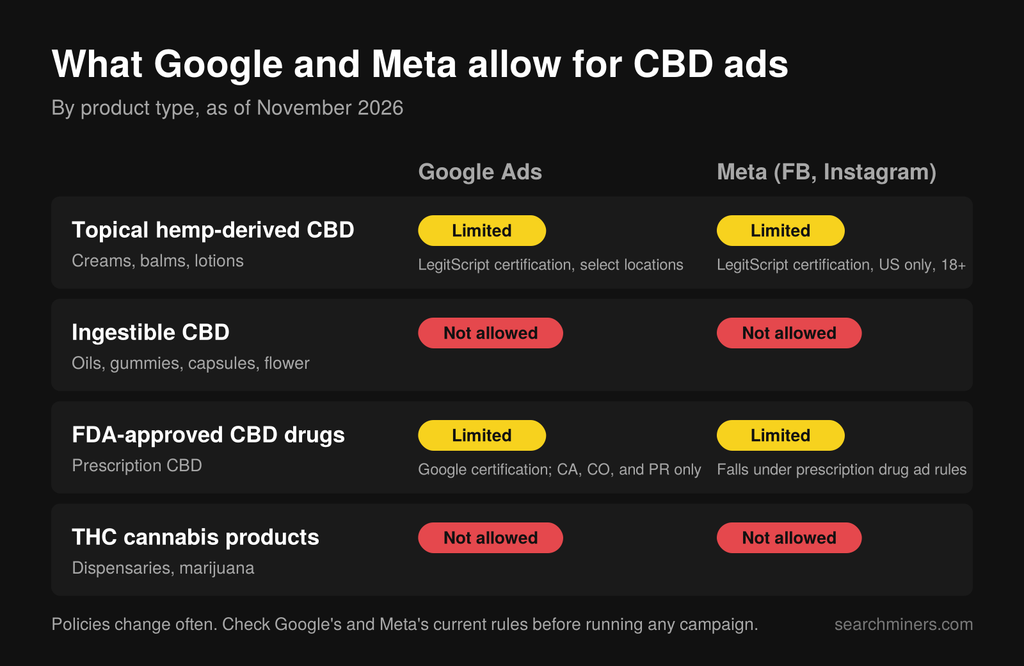
Google treats CBD under its policy on unapproved pharmaceuticals and supplements. As of this writing, it allows two narrow cases:
- FDA-approved pharmaceutical CBD. The advertiser has to be certified by Google, and ads can only run in California, Colorado, and Puerto Rico.
- Topical hemp-derived CBD. Advertisers in locations where Google permits CBD promotions first need certification from LegitScript, a third-party verification company. Then they apply to Google separately.
Ingestible CBD, like oils, gummies, capsules, and flower, isn’t covered by either exception. If that’s most of your catalog, Google Ads is effectively closed to you.
Even brands that qualify run into practical limits. The approved locations are small. Certification takes time and costs money. And ads can still get flagged if your landing pages mention products outside the approved category.
What Meta allows on Facebook and Instagram
Meta loosened its rules a few years ago, but the opening is small. It allows ads for topical hemp-derived CBD products in the US, again with LegitScript certification and with ads limited to adults 18 and older. Ingestible CBD products are still not allowed.
Meta also reviews the landing page. If the page an ad points to sells ingestibles, the ad can be rejected even when the product in the ad is a topical.
The rules are changing again
Congress narrowed the federal definition of hemp in late 2025. The new definition takes effect November 12, 2026. It measures total THC, including THCA, and caps finished hemp-derived products at 0.4 milligrams of total THC per container.
That cap mainly hits edibles, beverages, tinctures, and full-spectrum products. How it applies to other product types is still being worked out, so talk to a lawyer about your own catalog. For marketing, the takeaway is simple. Expect ad platforms to stay cautious, and expect the products you can promote to keep shifting.
Why most CBD brands can’t rely on paid ads
Put it together and the math rarely works:
- Most CBD revenue comes from ingestibles, which neither platform allows.
- Topical CBD ads are limited to certain locations and require certification.
- One wrong landing page can get ads or accounts suspended.
- Rules change often enough that a working campaign can stop working.
Compare that to a business in almost any other category, where paid search can bring in customers on day one while slower channels build. CBD brands don’t get that safety net. Dispensaries have it even harder, since THC products can’t be advertised on either platform. We cover what works for dispensaries instead
What works instead
Organic search
Search is the one large channel where nobody has to approve your ad. People search for “CBD flower,” “hemp flower,” and hundreds of related terms every day. If your pages rank, you get that traffic without paying per click.
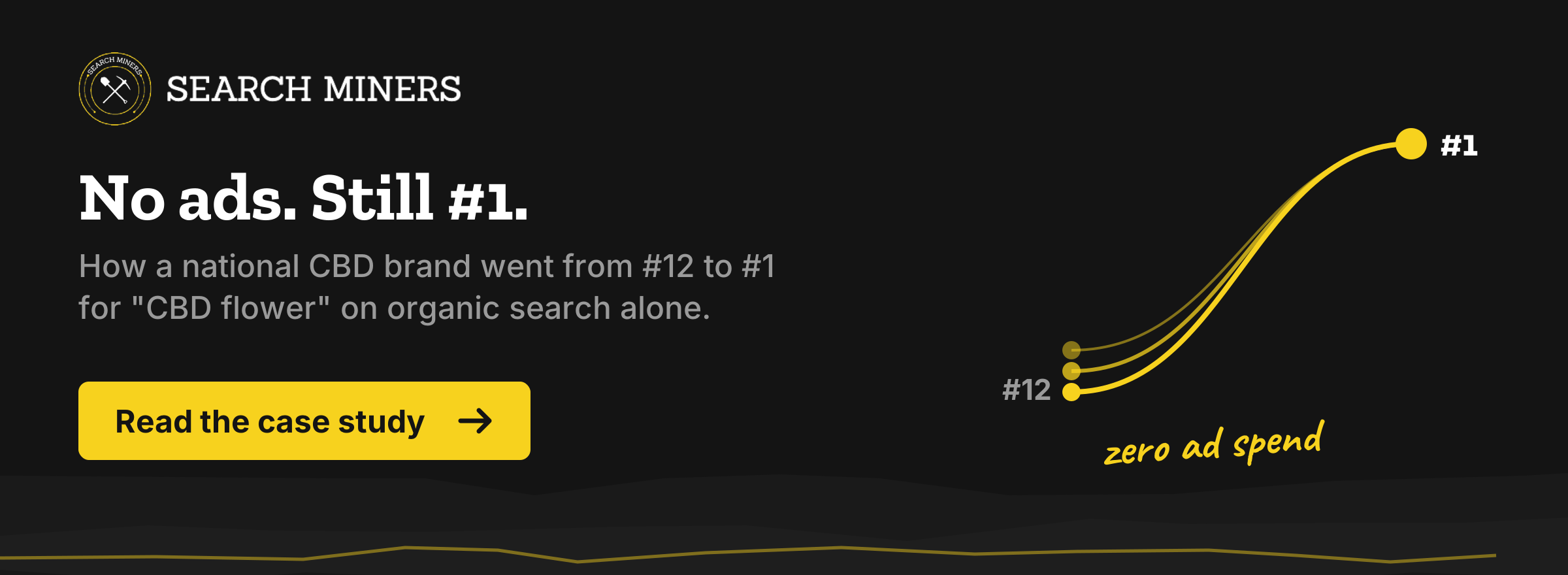
It takes longer than ads. One national CBD brand we worked with took about nine months to go from #10 to #12 to #1 for its three most important terms, with no paid ads at all. Organic traffic grew about tenfold at its peak. Here’s how we took a national CBD brand to #1
What moved the needle there wasn’t a trick. We rebuilt the core category and product pages so they loaded fast and were easy to shop. Better engagement lifted rankings, which brought more traffic. Then we earned placements in health, wellness, and cannabis publications to build the brand’s authority.
Email and SMS
People who already bought from you are your cheapest next sale. Build your list from day one. Check your email and SMS provider’s rules before you start, since some restrict cannabis and CBD content, and make sure your consent process follows federal texting rules.
Earned media and PR
Wellness, alternative health, and cannabis publications will cover CBD brands that have a real story. Coverage brings referral traffic and builds the authority that helps you rank.
Product content that builds trust
CBD buyers are skeptical, and they should be. Post lab results for every product. Explain sourcing, extraction, and potency in plain language. Show real reviews. Avoid claims that a product treats or cures anything. The FDA has sent warning letters to CBD companies over exactly that, and it costs you trust with buyers too.
Retail and wholesale
Shelf space in the right stores builds awareness that later shows up as branded searches. It’s slower and lower margin, but it’s a channel the ad platforms can’t take away.
Frequently asked questions
Can you run Google Ads for CBD oil?
In most cases, no. CBD oil is usually ingestible, and Google’s exceptions cover FDA-approved pharmaceutical CBD and topical hemp-derived CBD in limited locations.
Can you advertise CBD on Facebook or Instagram?
Only topical hemp-derived CBD, in the US, with LegitScript certification, aimed at adults 18 and older. Ingestibles are not allowed.
What is LegitScript certification?
It’s a third-party review that Google and Meta use to check that a CBD seller meets legal and product standards. It’s required before either platform will consider topical CBD ads.
What’s the best way to market CBD without ads?
Organic search is usually the biggest opportunity, backed by email, earned media, and trust-building product content. Our full guide to CBD marketing covers each channel in detail.
Get help growing without ads
We’ve taken a national CBD brand to #1 for “CBD flower” with no paid ads. See the full case study or meet with one of our experts to talk about your brand. You can also read about how we help cannabis and CBD brands with SEO
This article is for general information and isn’t legal advice. Ad policies and hemp laws change often. Check the current rules before you launch a campaign.
About Patrick Michaels
Patrick Michaels
Patrick brings 10+ years of SEO expertise and 15+ years of professional writing experience to the Search Miners team. He specializes in creating clear, actionable content strategies that drive real business growth.


