

Does Site Engagement Affect SEO? 6 Metrics to Monitor!

Thanks for reading! I hope you enjoyed reading and learning more about digital marketing, SEO, and how to increase your visibility online.
Author: Patrick Michaels | Lead Content Strategist at Search Miners
Site engagement can affect SEO indirectly. But Google does not treat common engagement metrics such as bounce rate, session duration, or Google Analytics engagement rate as straightforward ranking factors.
A page with a high engagement rate does not automatically rank higher. Likewise, a page with a high bounce rate does not automatically lose rankings.
However, engagement can reveal whether visitors find your content useful, easy to read, and relevant to their search intent. Improving those qualities can strengthen your overall SEO performance.
At Search Miners, we help businesses improve both technical SEO and the user experience that supports organic growth through a strong SEO Audit. Book a meeting with our team or call us at (760) 760-7170.
What Is Site Engagement?
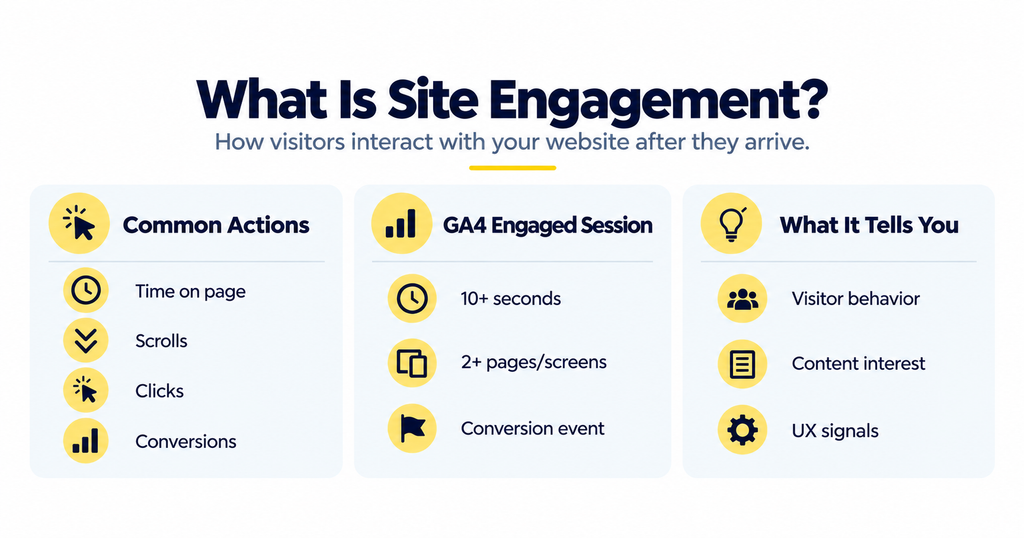
Site engagement describes how visitors interact with your website after they arrive. Depending on the analytics platform, engagement can include:
- Time spent viewing a page
- Pages viewed during a visit
- Scroll activity
- Clicks on internal links
- Video plays
- Form submissions
- Downloads
- Purchases
- Returning visits
- Other meaningful interactions
Google Analytics 4, for example, tracks an engagement session when a user stays on a page for at least 10 seconds, views at least two pages or screens, or triggers a conversion event. Engagement time also measures the amount of time a page remains in focus in the user’s browser.
These metrics help website owners understand visitor behavior. They do not, by themselves, tell Google to rank a page higher.
Site Engagement vs. Ranking Signals
| Metric or signal | Direct Google ranking factor? | Useful for SEO analysis? |
| Google Analytics engagement rate | No confirmed direct factor | Yes |
| Bounce rate | No confirmed direct factor | Yes |
| Average engagement time | No confirmed direct factor | Yes |
| Pages per session | No confirmed direct factor | Yes |
| Scroll depth | No confirmed direct factor | Yes |
| Conversion rate | No confirmed direct factor | Yes |
| Core Web Vitals | Yes, as part of Google’s ranking systems | Yes |
| HTTPS | Yes | Yes |
| Mobile-friendly experience | Important page experience consideration | Yes |
| Content relevance and usefulness | Central to Google’s ranking systems | Yes |
Google’s current documentation makes an important distinction: there is no single “page experience signal.” Instead, Google’s core ranking systems consider multiple signals related to the overall experience.

Is Your Website Ready for the AI Search Era?
Traditional SEO isn’t enough anymore. ChatGPT, Gemini, and AI Overview are changing how customers find businesses. Our GEO and semantic optimization strategies ensure you’re visible everywhere your customers are searching.
Stay ahead of the competition with cutting-edge optimization.
Is Engagement a Direct Google Ranking Factor?
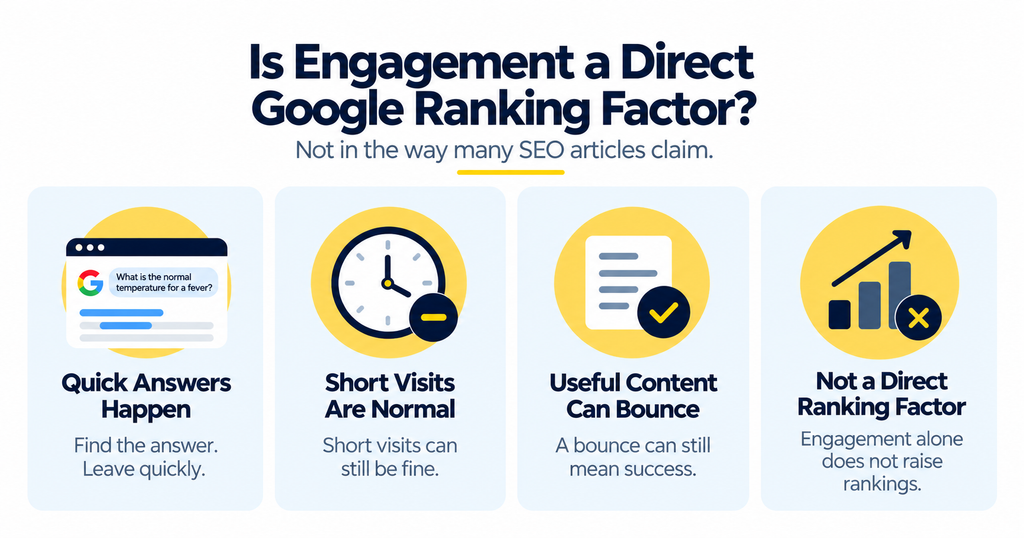
Not in the way many SEO articles claim.
Google does not publish a rule saying that a page will rank higher because visitors spend three minutes on it instead of one minute.
The same applies to bounce rate. A high bounce rate does not automatically mean that a page provides poor content.
Consider a simple example.
Someone searches:
“What is the normal temperature for a fever?”
They click your page, immediately find the answer, and leave.
Your analytics platform might record a short visit. Depending on the setup, that visit might also contribute to a high bounce rate.
But the visitor may have found exactly what they needed.
That behavior does not automatically mean your page failed.
Why Does Site Engagement Still Matter for SEO?
Even though engagement metrics do not work as simple ranking switches, they still matter to SEO. Good content tends to create better user experiences. Better experiences can lead to stronger business and search outcomes. For example, useful content can encourage visitors to:
- Read more of the page
- Visit related pages
- Click internal links
- Watch an embedded video
- Sign up for a service
- Complete a purchase
- Return to the website later
- Share the content
- Mention the website elsewhere
These behaviors can create valuable secondary effects. For example, a genuinely useful article may attract backlinks, generate brand searches, earn referrals, and encourage visitors to explore other pages. Those outcomes can contribute to stronger SEO over time.
Is Your Website Ready for the AI Search Era?
Traditional SEO isn’t enough anymore. ChatGPT, Gemini, and AI Overview are changing how customers find businesses. Our GEO and semantic optimization strategies ensure you’re visible everywhere your customers are searching.
Stay ahead of the competition with cutting-edge optimization.
Which Engagement Metrics Should You Monitor?
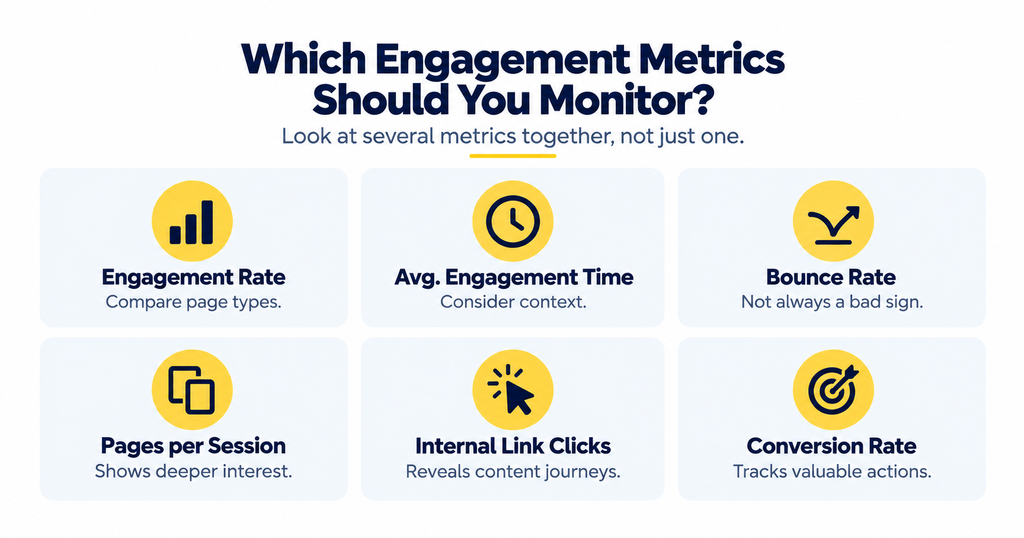
You should not obsess over a single engagement number. Instead, examine several metrics together.
1. Engagement Rate
Engagement rate tells you how many sessions meet Google’s GA4 definition of an engaged session. A high engagement rate can indicate that visitors interact meaningfully with your site.
However, compare pages within the same content type.
A blog post answering a simple factual question may naturally have less engagement than a detailed product comparison.
Do not assume the lower number automatically means worse SEO.
2. Average Engagement Time
Average engagement time tells you how long visitors actively engage with your content. This metric can help you identify pages that hold attention and pages that visitors abandon quickly.
But context matters.
A 30-second visit can represent success for a page that answers a simple question.
A 30-second visit may represent failure for a 2,500-word tutorial that requires detailed reading.
3. Bounce Rate
Bounce rate measures sessions that did not qualify as engaged sessions in GA4. It does not mean that every visitor who leaves immediately disliked your page.
A visitor can arrive, find the answer, and leave without taking another action.
For that reason, you should never optimize SEO simply by trying to reduce bounce rate.
4. Pages per Session
Multiple page views can indicate that visitors find your website useful enough to continue exploring. For example, someone reading a blog about technical SEO might then visit:
- Your technical SEO service page
- Your case studies
- And your contact page
That journey provides much more useful business information than simply knowing that the visitor stayed on the first article for three minutes.
5. Internal Link Clicks
Internal links can encourage visitors to discover related content. They also help search engines understand relationships between pages. For example:
SEO Audit Guide → Technical SEO Services → Contact Page
This structure creates a logical journey for visitors while helping search engines understand the relationship between your content.
6. Conversion Rate
Conversions often provide more actionable information than engagement alone. Depending on your business, a conversion might include:
- Contact form submission
- Phone call
- Appointment request
- Quote request
- Product purchase
- Newsletter signup
- Demo request
A page can have relatively low engagement but generate excellent leads. That page may perform better for the business than a highly engaging article that generates no customers.
What Does Google Say About User Experience?
Google explicitly connects page experience with search success. Its current guidance recommends checking several aspects of the experience, including:
- Core Web Vitals
- HTTPS
- Mobile display
- Intrusive interstitials
- Excessive advertisements
- Clear access to the main content
Google also states that its core ranking systems use Core Web Vitals and that good page experience can contribute to success in Search.
The current Core Web Vitals targets include:
| Metric | What it measures | Good target |
| LCP | Loading performance | 2.5 seconds or less |
| INP | Responsiveness | Under 200 ms |
| CLS | Visual stability | Under 0.1 |
These metrics matter because technical problems can directly interfere with engagement. If a page takes too long to load, shifts while someone tries to click, or responds slowly to interactions, visitors may leave before consuming the content.
Does Dwell Time Affect SEO?
Dwell time creates one of the biggest misconceptions in SEO.
Dwell time generally describes how long someone remains on a page after clicking a search result before returning to the search results.
SEO studies have found correlations between time on site and higher rankings.
For example, a Backlinko analysis of 11.8 million Google search results found that sites with above-average time on site tended to rank higher. The study reported an average time on site of about 2.5 minutes for first-page results. However, the researchers explicitly noted that the correlation does not prove that Google uses time on site as a direct ranking signal.
People may spend more time on highly ranked pages because those pages already provide better content, stronger brand recognition, or better answers.
So you should not write an article simply to make visitors stay longer.
You should make the article useful enough that visitors naturally spend the time they need.
7 Ways to Improve Site Engagement Without Manipulating Users
You should improve engagement by making your website more useful, not by trying to keep visitors on a page artificially.
1. Match Search Intent
Start by understanding what the searcher wants.
Someone searching “best accounting software for small business” expects different information from someone searching “what is accounting software.”
Match the content format, depth, and CTA to the query.
2. Answer the Main Question Early
Do not force visitors through a 1,500-word introduction before answering a simple question. Give them the answer first. Then provide supporting details.
This approach improves usability and can also make your content more effective in search.
3. Improve Page Speed
Slow pages create friction. Google recommends good Core Web Vitals for both Search success and overall user experience.
Focus on compressing images, using reliable hosting, enabling browser caching, and reducing unnecessary JavaScript and render-blocking resources. Improve server response times and prevent unexpected layout shifts to keep pages fast, stable, and easy to use.
4. Make Content Easy to Scan
Use short paragraphs, descriptive headings, bullet points, tables, relevant images, and practical examples to make your content easy to scan. Highlight key information in bold so readers can quickly find the points that matter most.
5. Add Relevant Internal Links
Help visitors discover the next useful piece of information by adding relevant internal links to topics such as technical SEO audits, site speed, crawlability, indexing, structured data, and SEO services. Avoid adding links just to increase page views. Every internal link should provide genuine value and help readers explore the topic further.
6. Use Clear Calls to Action
Tell visitors what they can do next. Depending on your goal, that might mean:
- Request a quote
- Book a consultation
- Download the guide
- Read the related article
- View our services
A clear CTA can turn engagement into measurable business value.
7. Remove Distractions
Excessive pop-ups, aggressive advertisements, autoplay media, and intrusive banners can make pages harder to use. Google specifically recommends avoiding intrusive interstitials and excessive ads that interfere with the main content.
How to Measure Whether Your Engagement Improvements Work
Do not change a page and immediately assume that a higher engagement rate means your SEO improved. Use a before-and-after comparison.
Track:
| Metric | What it tells you |
| Organic clicks | Whether Search traffic increased |
| Organic impressions | Whether visibility increased |
| Average position | How rankings changed |
| Organic CTR | Whether searchers choose your result |
| Engagement rate | Whether visits become meaningful sessions |
| Engagement time | Whether visitors actively consume content |
| Conversions | Whether traffic produces business results |
| Core Web Vitals | Whether the page provides a strong technical experience |
Google Search Console can provide Search performance data such as clicks, impressions, CTR, and average position.
Compare these numbers over an appropriate period instead of judging a page from a few days of data.
Should You Optimize for Engagement or Rankings?
Optimize for users first and search visibility second. Do not rewrite a page simply because its average engagement time looks low.
Before Optimizing a Page, Ask Yourself:
- How well does the page match the searcher’s intent?
- Can visitors find the main answer quickly?
- Is the content detailed enough to satisfy the topic?
- How accurately does the title describe the page?
- How well does the page perform on mobile devices?
- How quickly does the page load?
- Can visitors easily discover related information?
- How closely does the CTA match the visitor’s intent?
- What meaningful conversions does the page generate?
- What does Google Search Console reveal about its organic performance?
This approach produces more useful insights than trying to reach an arbitrary engagement-time target.
Improve Your Website’s SEO and User Experience with Search Miners!
Strong SEO requires more than attracting visitors from Google.
Your website also needs to give those visitors a useful, fast, and friction-free experience once they arrive.
Search Miners can help identify technical SEO problems, content gaps, page experience issues, and opportunities to improve your organic performance.
Our SEO team can evaluate how your website performs across search visibility, user experience, content, technical health, and conversions.
If your organic traffic is growing but visitors are not engaging or converting, a deeper SEO and website analysis can help identify where the problem starts.
Contact Search Miners to discuss your SEO strategy and find opportunities to improve your website’s search performance.
People Also Ask
Can site engagement improve conversions?
Yes. Strong engagement can move visitors closer to conversion by helping them find relevant information, understand your offer, and take the next step. Track engagement alongside leads, purchases, and other conversion actions.
How can I tell if visitors are engaged with my website?
Look at multiple behaviors, including engaged sessions, engagement time, internal link clicks, video interactions, downloads, form submissions, and conversions. No single metric provides a complete picture.
Why do users leave a website quickly?
Visitors may leave because they cannot find the information they need, the page loads slowly, the content does not match their search intent, or intrusive elements interrupt their experience. A quick exit does not always indicate a poor page.
Does internal linking improve user engagement?
Relevant internal links can encourage visitors to explore related content and find answers to additional questions. They can also help search engines understand the relationships between pages on your website.
How does mobile experience affect site engagement?
A difficult mobile experience can cause visitors to leave before they interact with your content. Responsive design, readable text, fast loading, easy navigation, and properly sized interactive elements can create a better mobile experience.
Can poor website design hurt engagement?
Yes. Cluttered layouts, confusing navigation, difficult-to-read text, excessive pop-ups, and unclear calls to action can make it harder for visitors to use your website and complete their goals.
How often should I review website engagement metrics?
Review your engagement data regularly and compare trends over time rather than reacting to short-term changes. Analyze important pages after major content, design, technical, or SEO changes to identify meaningful shifts in user behavior.
About Patrick Michaels
Patrick Michaels
Patrick brings 10+ years of SEO expertise and 15+ years of professional writing experience to the Search Miners team. He specializes in creating clear, actionable content strategies that drive real business growth.


![WooRank Alternative [Top 6 Similar Tools for SEO Analysis]](https://www.searchminers.com/wp-content/uploads/2025/09/WooRank-Alternative-Top-6-Similar-Tools-for-SEO-Analysis-768x480.jpg)
![SEO Guarantee [Red Flags, Realistic Promises, & What to Ask]](https://www.searchminers.com/wp-content/uploads/2026/06/SEO-Guarantee-Red-Flags-Realistic-Promises-and-What-to-Ask-768x480.jpg)

