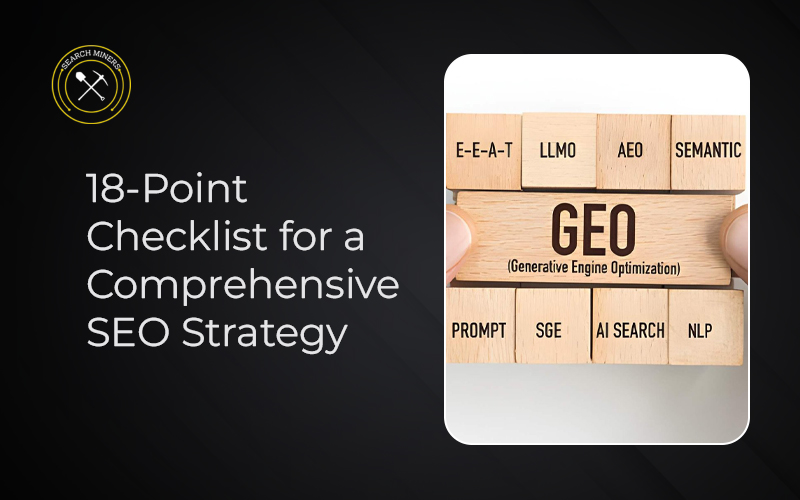
18-Point Checklist for a Comprehensive SEO Strategy

Thanks for reading! I hope you enjoyed reading and learning more about digital marketing, SEO, and how to increase your visibility online.
Author: Patrick Michaels | Lead Content Strategist at Search Miners
A comprehensive SEO strategy is a connected plan that fixes your site’s technical health, structures every page correctly, earns authority from other credible sites, wins your local market, and builds content around real customer questions, all pointed at the same business goal.
Most business owners don’t have that. They have a pile of separate tasks. A blog post here. A few keywords there. A plugin that promised to “fix SEO” in one click.
Rankings come from every part working together, not from one part working hard.
Search Miners, a Las Vegas SEO Company, builds strategy first and tactics second. Every audit, every content calendar, and every link we earn for a client ties back to one plan, not a scattered checklist.
Our work starts with an SEO Audit Service, a full review of your site’s technical health, on-page setup, backlink profile, and local visibility.
You will know exactly which parts of this checklist your site is already meeting and which parts still need work.
What Makes An SEO Strategy Comprehensive?
A strategy earns that word when it covers five things at once:
- What search engines can technically read,
- How each page is structured,
- What other sites and sources say about you,
- How well you compete in your local market
- What your content actually says to the person reading it.
Miss one, and the other four carry the weight of it.
Each of these parts affects the others directly.
Ahrefs’ study of over a billion pages found that 96% of pages get zero traffic from Google, and most of that failure comes from exactly this pattern: one part of the site done well, sitting on top of three or four parts nobody touched.
A page with strong content still won’t rank if search engines can’t crawl it.
A site with strong technical health still won’t convert if the content on it doesn’t answer the visitor’s question.
And a business with strong content and links still loses local customers if its Google Business Profile is incomplete.
Google’s own guidance supports this. Its Search Essentials documentation states that pages need to be crawlable, contain genuinely useful content, and be seen as credible by other sources on the web.
These are the same core requirements, stated directly rather than left as suggestions.

Is Your Website Ready for the AI Search Era?
Traditional SEO isn’t enough anymore. ChatGPT, Gemini, and AI Overview are changing how customers find businesses. Our GEO and semantic optimization strategies ensure you’re visible everywhere your customers are searching.
Stay ahead of the competition with cutting-edge optimization.
Why Do Most SEO Efforts Stall Out?
They stall because businesses fix the part they understand and skip the parts they don’t. A few patterns show up again and again:
- A business owner comfortable with writing publishes blog posts for months and sees no results, because the site runs on a slow theme with duplicate title tags underneath.
- A business owner who hired a developer once ends up with a fast, clean site that still has three pages of content from 2019.
- A local business with a well-designed website loses customers to a competitor with a weaker site but a fully completed Google Business Profile, because most nearby searches never go past the map results.
There’s a second, newer reason SEO stalls. Search has split into two channels.
People still type into Google, but they also ask ChatGPT and Perplexity directly, and those tools summarize an answer instead of listing ten links.
A site built only for keyword-matching gives an AI system nothing clear to summarize.
Semantic SEO addresses this by writing pages around the actual meaning of a question, so both Google and AI tools can pull an accurate answer from the content.
Technical SEO
Technical SEO decides whether search engines can find, read, and trust your site.
Without it, nothing else in this guide matters, because strong content does nothing if Google never indexes the page it’s on.
1- Crawlability: Can Search Engines Find Your Pages?
Search engines discover your pages through links and through an XML sitemap, a file that lists every page you want indexed.
A robots.txt file tells crawlers which sections to skip, and a mistake here, blocking an important folder by accident, is one of the most common reasons a site loses its search visibility.
Check both files early in any audit.
2- Page Speed And Core Web Vitals
Page speed carries more weight than most business owners assume.
Google research conducted with SOASTA found that as page load time goes from one second to five seconds, the probability of a mobile visitor leaving the page increases by 90%.
That’s a direct loss of traffic, not a minor detail.
Google’s Core Web Vitals, which measure loading speed, interactivity, and visual stability, factor directly into rankings, so slow pages lose visitors and ranking position at the same time.
3- Mobile-First Indexing
Google uses mobile-first indexing, meaning it primarily evaluates the mobile version of your site to decide how everything ranks, even for searches done on a desktop.
A site that displays correctly on a laptop but breaks on a phone is being judged on the broken version. You need to be mindful of mobile SEO for site optimization.
4- Security, Site Structure, And Duplicate Content
HTTPS is a standard requirement now, not an upgrade.
A clean site structure, where every page is a few clicks from the homepage, helps both visitors and crawlers understand how content connects.
Duplicate content, the same or similar page existing at multiple URLs, splits ranking value between them instead of concentrating it.
Canonical tags or consolidation matter more than most site owners realize.
5- Schema Markup For Search Engines And AI Tools
Schema markup is structured data added to a page’s code.
It gives search engines and AI tools a clear, machine-readable description of what’s on the page, which is the kind of clarity AI Overviews and chatbots rely on when deciding what to cite.
On-Page SEO
On-page SEO covers everything you control directly on a given page.
It’s where most of the actual persuasion happens, both for the search engine deciding whether to rank you and for the visitor deciding whether to stay.
6- Title Tags And Meta Descriptions
Title tags and meta descriptions are what a searcher sees before clicking.
Position matters here: the first organic result earns a much higher share of clicks than results further down the page, and that share drops with every position after it.
A page that ranks decently but has a flat, generic title tag loses clicks it should be getting.
7- Header Tag Structure
Header tags, your H1, H2, and H3 structure, organize the page for a reader looking for an answer and for a crawler trying to understand what the page covers.
One clear H1 stating the main topic, followed by H2s for each subtopic, is easier for both people and machines to read.
8- Keyword Placement And Internal Linking
Keyword placement should follow the meaning of the topic, not force a phrase into every sentence.
Modern search engines understand synonyms and related concepts, so writing naturally about a topic performs better than repeating an exact phrase.
Internal linking, connecting related pages with descriptive link text, spreads authority across the site and keeps visitors moving to the next relevant page instead of leaving.
9- Image Optimization And URL Structure
Image optimization, meaning compressed file sizes and descriptive alt text, supports page speed, accessibility, and image search at the same time.
URL structure should stay short and readable; a URL that describes the page in plain words performs better than a string of numbers and parameters.
10- E-E-A-T: Experience, Expertise, Authoritativeness, Trustworthiness
E-E-A-T is Google’s framework for judging Experience, Expertise, Authoritativeness, and Trustworthiness.
It matters most for pages covering health, money, or safety, but it affects how every page is evaluated.
An author bio, clear sourcing, and content written by someone who actually does the work all support this.
Off-Page SEO
Off-page SEO covers what other parts of the internet say about you.
Search engines use it as an independent signal of credibility that you can’t create by editing your own site.
11- Backlinks As A Ranking Signal
Backlinks, other websites linking to yours, remain one of the strongest ranking signals available, particularly links from sites that are established and relevant to your industry.
Multiple large studies analyzing top-ranking pages have found a consistent correlation between backlink quality and ranking position.
Quality matters more than quantity here; one link from a respected industry publication typically outweighs dozens of links from low-value directories.
12- Digital PR And Earning Links
Earning strong links means creating something worth linking to.
Original research, a genuinely useful free tool, or coverage-worthy work in your community gives journalists, bloggers, and other site owners a real reason to reference you.
Digital PR, meaning actively pitching that work to relevant publications, and guest contributions to respected industry sites both build the same kind of authority.
13- Brand Mentions And Reviews
Brand mentions matter even without a link attached.
Search engines increasingly track entities, recognizing your business name as a real-world subject with a reputation, and unlinked mentions across news, forums, and social platforms still support that recognition.
Reviews fall into this category too; a steady stream of them signals to both customers and search engines that an active business is behind the website.
Local SEO
Local SEO decides whether nearby customers find you at all.
For most brick-and-mortar and service-area businesses, it deserves as much attention as every other part of this guide combined.
14- Your Google Business Profile
Your Google Business Profile is the center of local SEO work.
A complete profile, with accurate categories, current hours, real photos, and regular posts, directly affects whether you appear in the map results that most local searches rely on.
An incomplete or outdated profile costs you those customers, and a competitor with a completed profile picks them up instead.
15- NAP Consistency And Local Citations
NAP consistency means keeping your Name, Address, and Phone number identical across your website, your Google Business Profile, and every directory listing.
Conflicting information across platforms makes it harder for search engines to confirm which details are correct.
That lowers both trust and local rankings.
Local citations, listings on relevant directories for your industry and city, reinforce that consistency and add further signals of legitimacy.
16- Service-Area Content And Local Reviews
Localized content matters as much as the listings themselves.
Service-area pages built for each city or neighborhood you actually serve, written with specific, real detail rather than the same paragraph with a new city name swapped in, give search engines a genuine reason to rank that page for that location.
Reviews serve a similar function here; local review volume and recency are direct ranking factors for map results, not just a trust signal for visitors.
Semantic SEO And AI Search
Search now runs on two channels, and a comprehensive strategy needs to address both.
17- Traditional Search Versus AI-Generated Answers
The first channel is traditional Google search, which now relies heavily on understanding meaning and intent rather than matching exact keyword strings.
The second channel is AI-generated answers: ChatGPT, Perplexity, and Google’s AI Overviews, which read across the web and produce a direct answer instead of a list of links.
Semantic SEO is the practice of writing content around the actual meaning behind a question, structured clearly enough that both systems can extract an accurate answer.
AI search visibility is more important now than ever.
18- Topic Clusters Earn Citations
Topic clusters and pillar pages, groups of connected pages that cover every angle of a subject, tend to outperform scattered, one-off posts.
A cluster gives an AI system several consistent, well-organized sources that agree with each other, which is the kind of pattern these systems favor when deciding what to cite.
Structured data, the same schema markup covered in the technical section, gives AI tools a clear, unambiguous version of your key facts to reference.
Without this, a site can still rank fine in Google while getting skipped in the growing share of searches that never reach a search results page at all.
How Do You Build All Of This Step By Step?
Every strategy follows the same order, because each step depends on the one before it.
Step 1: Audit Before You Make Any Changes
Before writing a single new page, find out what’s broken across every part covered above.
Crawl the site for slow pages, broken links, indexing errors, and duplicate content.
Check your Google Business Profile completeness and your NAP consistency across directories. This step alone often explains months of flat traffic.
Step 2: Research What Your Customers Actually Ask
Keyword research isn’t about placing a phrase on a page.
It’s about mapping the real questions a customer asks before they buy, and organizing your site around those questions in the order a customer would ask them.
Step 3: Build Content Around Clusters, Not Single Posts
Group related questions into a cluster, link them to each other, and let one strong pillar page anchor the group.
This structure is why content strategy work matters more than any individual post; it turns scattered writing into a topic that Google and AI tools recognize you cover thoroughly.
Step 4: Fix The Technical Foundation Alongside The Content
Page speed, mobile usability, secure connections, schema markup, and clean site structure aren’t a separate project from content.
They determine whether your content ever gets the chance to rank.
Publishing strong content on a technically weak site limits its results significantly.
Step 5: Build Your Local Presence In Parallel
If you serve a physical area, complete and actively manage your Google Business Profile, correct NAP inconsistencies, and build specific service-area content alongside your other work.
Local work runs on its own timeline and doesn’t need to wait for the rest of the strategy to finish.
Step 6: Earn Authority Instead Of Chasing It
Backlinks and mentions still carry real weight, but the businesses that earn strong ones are the ones producing something worth linking to.
Pursuing links without that underlying substance rarely holds up over time.
Step 7: Measure The Right Numbers Every Month
Rankings are a lagging signal.
Track organic traffic, page-one keyword count, local map visibility, and conversions from organic visits every month, so you catch a problem while it’s still small.
What Does This Look Like In Practice?
The Problem: A Website That Existed But Didn’t Perform
One of our Las Vegas home services clients came to us with a familiar problem: a website that had existed for years but generated almost no calls.
The audit identified the issues quickly.
Dozens of thin, duplicate location pages were competing against each other, the core service pages loaded too slowly to hold a visitor’s attention, and the Google Business Profile hadn’t been updated in over a year.
The Fix by Search Miners And The Result
We consolidated the duplicate pages into a smaller set of complete ones and rebuilt the content around the actual questions customers were asking before calling.
We then fixed the technical issues slowing the site down, and updated the Google Business Profile with real photos and consistent categories.
Within four months, the client’s page-one keyword count had grown several times over. The map-pack visibility for core service terms improved, and organic and local search combined became the largest source of new bookings, ahead of paid ads.
The result came from addressing every part of the strategy in the right order, not from a single change.
What Mistakes Undo A Good Strategy?
Several habits derail otherwise solid work.
1- Treating SEO As A Launch Instead Of A System
A site optimized once and left alone loses ground over time as competitors keep publishing and Google’s standards keep changing.
2- Chasing Keyword Volume Over Intent
A high-volume keyword with no buying intent behind it brings traffic that doesn’t convert, which looks good in a report and does nothing for revenue.
3- Ignoring Local SEO Entirely
A business with a strong national content strategy but an abandoned Google Business Profile is invisible to the nearby customers most ready to buy right now.
4- Ignoring How AI Tools Read Your Site
More customers ask AI assistants for recommendations before searching Google directly. A site with unclear or poorly structured answers gets left out of that recommendation entirely, even if it still ranks well in traditional search.
How Do You Measure And Maintain All Of This Over Time?
A comprehensive strategy requires consistent tracking on a fixed schedule, not occasional checks when something seems off.
The Tools That Matter
Google Search Console shows how Google sees your site: which pages are indexed, which queries bring in clicks, and which technical errors need fixing. Google Analytics tracks what happens after a visitor arrives, which pages convert and which ones lose visitors immediately. A rank tracking tool, alongside a broader platform like Ahrefs or Semrush, shows where your keywords sit and what your competitors are doing differently.
The Four Numbers To Track Every Month
Track four numbers every month, without exception.
- Organic traffic, so a decline gets caught early rather than at the end of a quarter.
- Page-one keyword count across your core topics, the clearest single measure of overall progress.
- Local map visibility, if any part of your business depends on nearby customers.
- And conversions from organic and local traffic specifically, because rising traffic with flat revenue usually means the wrong keywords are ranking, not the right ones.
Organic search drives well over half of all trackable website traffic, more than any other channel, which is why a decline in that number needs attention immediately.
How Does Search Miners Build This For Clients?
Search Miners treats technical health, on-page structure, off-page authority, local visibility, and content as one connected system, because that’s how search engines and AI tools evaluate a site.
Our Las Vegas SEO specialists start every engagement with a full audit across all five parts, then build a plan around what that audit finds, not around a generic template.
If your SEO efforts have felt disconnected or stuck despite real effort, book an SEO audit with Search Miners or call us at (760) 760-7170, and we will show you exactly which part is holding your site back.
People Also Ask
How Long Does A Comprehensive SEO Strategy Take To Show Results?
Technical fixes can move within weeks. Content, authority-building, and local visibility typically need three to six months of consistent work before rankings shift meaningfully, and competitive keywords can take longer.
Do I Need To Do Technical, On-Page, Off-Page, And Local SEO All At Once?
Not in the same week, but all within the same plan. Sequencing them correctly, audit first, content and technical work together, local and authority ongoing, matters more than doing everything simultaneously.
Is SEO Still Worth It With AI Search Tools Growing?
Yes, and arguably more than before. AI tools draw their answers from the same well-structured, credible content that ranks well in traditional search, so a strong SEO foundation supports both channels at once.
Can A Small Business Compete With Larger Competitors On SEO?
Yes, particularly on specific, well-answered questions that larger competitors write too generally to rank for, and on local search, where a completed Google Business Profile often outperforms a much larger budget.
What’s The Difference Between On-Page And Off-Page SEO?
On-page SEO covers everything you control directly on your own pages: titles, headers, content, and structure. Off-page SEO covers signals from elsewhere on the internet, backlinks, mentions, and reviews, that you can influence but not fully control.
How Important Is Local SEO If I Also Sell Online?
It remains important for any business with a physical location, service area, or in-person customer base. A business selling nationally online can often deprioritize it, but any business with a storefront or service radius loses real revenue by skipping it.
About Patrick Michaels
Patrick Michaels
Patrick brings 10+ years of SEO expertise and 15+ years of professional writing experience to the Search Miners team. He specializes in creating clear, actionable content strategies that drive real business growth.