Inbound Links vs Backlinks: What’s the Difference in SEO?

Thanks for reading! I hope you enjoyed reading and learning more about digital marketing, SEO, and how to increase your visibility online.
Author: Patrick Michaels | Lead Content Strategist at Search Miners
Every time another website links to yours, Google sees it as a signal that your business is worth trusting. That trust turns into rankings. Those rankings turn into customers.
Most businesses don’t realize their competitors are outranking them, not because of better products or services, but because of stronger link authority. It’s one of the most overlooked growth levers in SEO.
At Search Miners, we help businesses build that authority the right way, earning links that improve rankings and drive real organic growth across Google and AI-powered search.
What Are Backlinks in SEO?
A backlink is a link on someone else’s website that points to yours.
When credible sites link to you, Google sees it as a vote of confidence. More trust signals mean better rankings, stronger domain authority, and more organic traffic, all without paying for a single click.
A popular marketing blog writes about SEO agencies and links to Search Miners as a top Las Vegas SEO company.
That link is a backlink for Search Miners, an outside source vouching for the brand in Google’s eyes.

Is Your Website Ready for the AI Search Era?
Traditional SEO isn’t enough anymore. ChatGPT, Gemini, and AI Overview are changing how customers find businesses. Our GEO and semantic optimization strategies ensure you’re visible everywhere your customers are searching.
Stay ahead of the competition with cutting-edge optimization.
What Are Inbound Links?
An inbound link is any link coming into your website from an external domain. The name describes direction, authority, and traffic flow inward toward your site from somewhere else on the web.
The word inbound simply means coming in.
When an outside website sends a visitor your way through a link, that traffic, trust, and authority all travel inward. That’s why the term exists.
A Las Vegas business directory lists your company and links to your website. A potential customer clicks it and lands on your service page.
You just got referral traffic and an SEO signal at the same time.
Inbound Links vs Backlinks: Are They Different?
In SEO, backlinks and inbound links mean the same thing. Both describe a link from an external website pointing to your site.
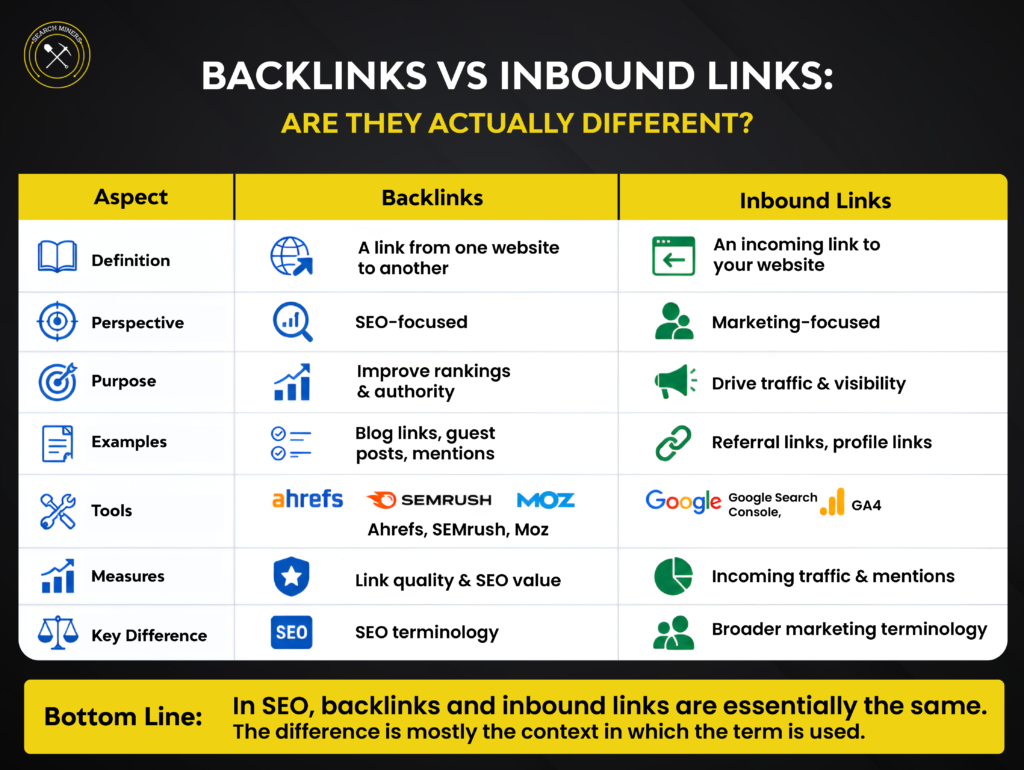
Use either term, and any SEO professional will understand you immediately.
Different tools use different words.
Google Search Console calls them “links.”
Ahrefs uses “backlinks.”
Some older marketing content uses “inbound links” more broadly to describe any external traffic source, including brand mentions that don’t always include a clickable link.
Technical Perspective vs Marketing Perspective
From a pure SEO standpoint, backlinks and inbound links are identical concepts.
From a broader marketing standpoint, some teams stretch “inbound links” to mean any external signal driving traffic to a site.
But for rankings and link-building strategy, they refer to the same thing.
How Can Backlinks and Inbound Links Help SEO?
Backlinks do more than just improve rankings.
They build trust, bring in real traffic, and tell Google your website is a credible source worth showing to more people.
1- Improve Search Engine Rankings
Google has confirmed that backlinks are one of its top three ranking factors.
According to Google’s own Search Quality Rater Guidelines, expertise, authoritativeness, and trustworthiness, commonly known as E-E-A-T, are core to how Google evaluates pages, and backlinks play a direct role in establishing all three.
If two businesses sell the same service, the one with more credible websites linking to it will almost always outrank the other.
2- Increase Website Authority
Every quality link your site earns makes your entire domain more trustworthy in Google’s eyes.
A local Las Vegas contractor who gets linked to by a major home improvement publication will see that authority spread across every page on their site, not just the one that was linked to.
3- Help Search Engines Discover Pages
Google crawls the web by following links.
If you launch a new service page but no one links to it, Google might take weeks to find it. Inbound links act like roads; they lead search engines straight to your content faster.
4- Drive Referral Traffic
A backlink on a busy, relevant website sends real visitors to your site.
If a popular local blog in Las Vegas links to your business, their readers click that link and land on your page.
The way people respond to external references and recommendations is tied to how advertising and influence techniques affect consumer behavior, and backlinks work on that same principle of borrowed trust.
That’s new traffic that has nothing to do with your rankings, but a direct business benefit on top of the SEO value.
5- Build Brand Trust and Credibility
When well-known, respected websites link to you, people trust your brand more, and so does Google.
A dentist linked to a health authority site instantly looks more credible than one with no outside references at all.
The Nielsen Norman Group found that credibility and sourcing are among the top factors that determine whether users trust and share content online, both of which directly influence how many inbound links a piece earns.
Quality always beats quantity here.
Ten links from strong, relevant websites will do more for your SEO than five hundred links from random, low-quality ones.
In fact, trust signals go beyond just links, if your site is getting traffic but no calls, weak authority and poor credibility signals are often the real reason behind it.
Types of Backlinks and Inbound Links
Not every backlink is built the same. The type of link, where it comes from, and how it was earned all determine how much SEO value it actually passes to your site.
A well-planned backlinks management strategy ensures you are earning the right types of links from the right sources, not just accumulating volume with no real SEO impact.
1- Natural Editorial Links
These are the most valuable links you can earn.
They happen when another website links to your content simply because it was helpful, well-researched, or worth referencing.
2- Guest Post Links
When you write an article for another website in your industry, you typically earn a link back to your site.
It’s a good way to build authority in your niche while getting in front of a new audience.
3- Business Directory Links
Platforms like Yelp, BBB, and industry-specific directories link back to your website when you create a listing.
These are easy to earn and useful for local SEO.
4- Local SEO Citations
Your name, address, and phone number, listed consistently across the web, tell Google your business is real, local, and trustworthy.
That’s a citation. Link or no link, it counts. And the more trusted directories carry your information, the stronger your local presence gets.
5- Digital PR Links
When journalists, bloggers, or media outlets cover your brand, publish your data, or quote you as an expert, you earn links from high-authority sources.
These are some of the most powerful backlinks you can get.
6- Dofollow vs Nofollow Links
A dofollow link passes SEO authority directly to your site; this is what most link building focuses on.
A nofollow link tells search engines not to pass that authority, but it still drives real traffic and adds to your brand’s visibility across the web.
Is Your Website Ready for the AI Search Era?
Traditional SEO isn’t enough anymore. ChatGPT, Gemini, and AI Overview are changing how customers find businesses. Our GEO and semantic optimization strategies ensure you’re visible everywhere your customers are searching.
Stay ahead of the competition with cutting-edge optimization.
How to Earn Better Inbound Links Naturally
Building inbound links naturally takes strategy, not shortcuts.
These are the most effective ways to earn links that improve your rankings and grow your authority over time.
1- Create Helpful Content
Content that genuinely solves a problem earns links without you having to ask.
A Las Vegas roofing company that publishes a detailed guide on spotting storm damage will naturally get referenced by local news sites, home improvement blogs, and insurance resources.
Useful content gives other websites a reason to link to you.
2- Publish Original Research
When you produce original data, a survey, a case study, or an industry report, journalists and bloggers need somewhere to source it from.
Put out something worth citing, a study, a stat, a finding, and let others do the linking for you.
One strong piece of original research can pull in dozens of high-authority editorial links naturally. No cold emails or outreach grind, but content that earns its place.
3- Use Digital PR
Digital PR means getting your brand, your data, or your expertise in front of journalists and publishers who cover your industry.
One feature in a major publication can earn a backlink worth more than a hundred directory listings.
It also builds brand recognition that compounds over time.
4- Build Industry Relationships
The businesses that earn the most natural links aren’t always producing the best content; they are the most connected. When you build genuine relationships with other businesses, bloggers, and publishers in your space, linking opportunities come up organically.
Collaborate, contribute, and show up consistently in your industry.
5- Optimize for GEO and AI Search Visibility
AI-powered search tools like Google’s AI Overviews pull answers from sources that are credible, well-referenced, and authoritative across the web.
Earning links today also means earning citations in AI-generated answers tomorrow.
Search Miners builds SEO and GEO strategies that help businesses earn visibility across both traditional Google search and the AI-powered search experiences that are rapidly becoming the new normal.
Are Backlinks Still Important for SEO in 2026?
Yes, backlinks are still one of the strongest ranking signals Google uses, and that hasn’t changed despite years of algorithm updates.
But in 2026, the way link value works has expanded.
Unlinked brand mentions still count. When your business is referenced across the web, even without a clickable link, search engines and AI tools take note.
Google’s AI Overviews favor sources that are well-linked and widely talked about. The more your brand shows up, the more authority you build.
So a strong backlink profile today does more than improve your Google rankings; it also increases your chances of showing up in AI-generated search answers, which is where more and more searches are heading.
Want Stronger SEO Authority and Better Link Signals?
Search Miners helps businesses grow organic visibility through SEO, GEO, content strategy, and authority-focused link building.
We build long-term strategies that improve rankings, brand visibility, and performance across search and AI-powered search experiences.
Book a consultation with Search Miners today and get a backlink plan for long-term ranking strength.
Rank Higher in Las Vegas Search Results
Get exclusive SEO insights, digital marketing strategies, and growth tips delivered straight to your inbox. Join business owners who are already using our expert advice to attract more customers and grow their revenue.
People Also Ask
Why are backlinks important for rankings?
A page that earns links from credible, relevant websites is seen as more trustworthy than one that hasn’t. That trust directly translates into higher rankings and more organic visibility.
What makes a backlink high-quality?
The linking site should be in a related industry, have real traffic and credibility, and the link should sit naturally within the content. A single link from the right website can outperform dozens of weak ones.
Can bad backlinks hurt SEO?
Links from spammy, irrelevant, or purchased link networks can trigger a manual penalty from Google or cause algorithmic ranking drops. If you suspect bad links are hurting your site, a link audit is the first step.
How do websites earn inbound links naturally?
The businesses that earn the most links consistently do a few things well: they publish content that answers real questions, they put out original data that journalists want to cite, and they build genuine relationships within their industry. Links follow credibility. Build that first, and the links come with it.
About Patrick Michaels
Patrick Michaels
Patrick brings 10+ years of SEO expertise and 15+ years of professional writing experience to the Search Miners team. He specializes in creating clear, actionable content strategies that drive real business growth.

![SEO Guarantee [Red Flags, Realistic Promises, & What to Ask]](https://www.searchminers.com/wp-content/uploads/2026/06/SEO-Guarantee-Red-Flags-Realistic-Promises-and-What-to-Ask-768x480.jpg)