

How Much Does SEO Cost for a Small Business in 2026? Calculate Now

Thanks for reading! I hope you enjoyed reading and learning more about digital marketing, SEO, and how to increase your visibility online.
Author: Patrick Michaels | Lead Content Strategist at Search Miners
Small business SEO costs in 2026 typically range from $500 to $5,000+ per month, depending on competition, location, website size, and growth goals. Use our SEO Cost Calculator to get a realistic estimate for your business.
Find Out How Much SEO Really Costs
Get a personalized SEO cost estimate based on your goals, competition, and target market.
Some businesses need local visibility in one city. Others are competing nationally against brands with massive content teams and years of authority. The price of SEO reflects that difference.
At Search Miners, we work with small businesses across the US every week, from Las Vegas service companies to e-commerce stores trying to grow past PPC costs.
One of the first things every owner asks us is: “What is this SEO package going to cost me?”
By the end of this, you will know what drives SEO pricing, what a $500 package looks like versus a $3,000 one, and how to figure out a budget that makes sense for your business.
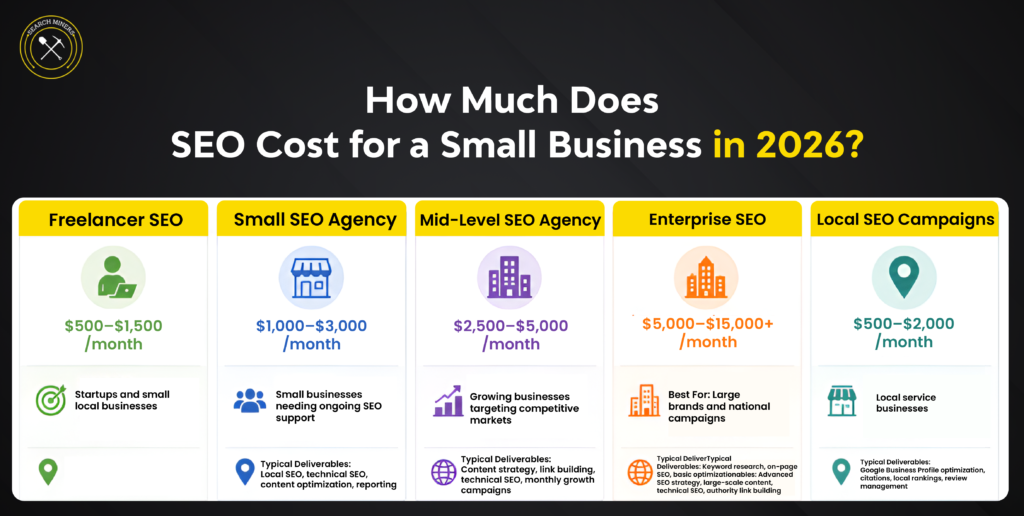
SEO Cost for Small Businesses
For small businesses in the US in 2026, this is what SEO typically costs:
| Service Type | Typical Cost | Scope |
| Freelancer SEO | $75–$150/hr or $500–$1,500/mo | Local/small |
| Small SEO agency | $1,000–$3,000/mo | Local |
| Mid-level agency | $2,500–$5,000/mo | Regional/national |
| Enterprise / competitive markets | $5,000–$15,000+/mo | National |
| Local SEO (single city or region) | $500–$2,000/mo | Local |
| National SEO campaigns | $2,500–$10,000+/mo | National |
| One-time SEO audit or project | $500–$5,000 flat fee | One-time |
The right number depends on your competition, goals, and current website health.

Is Your Website Ready for the AI Search Era?
Traditional SEO isn’t enough anymore. ChatGPT, Gemini, and AI Overview are changing how customers find businesses. Our GEO and semantic optimization strategies ensure you’re visible everywhere your customers are searching.
Stay ahead of the competition with cutting-edge optimization.
8 Factors That Affect SEO Pricing
These eight factors shape almost every SEO quote you will ever receive.
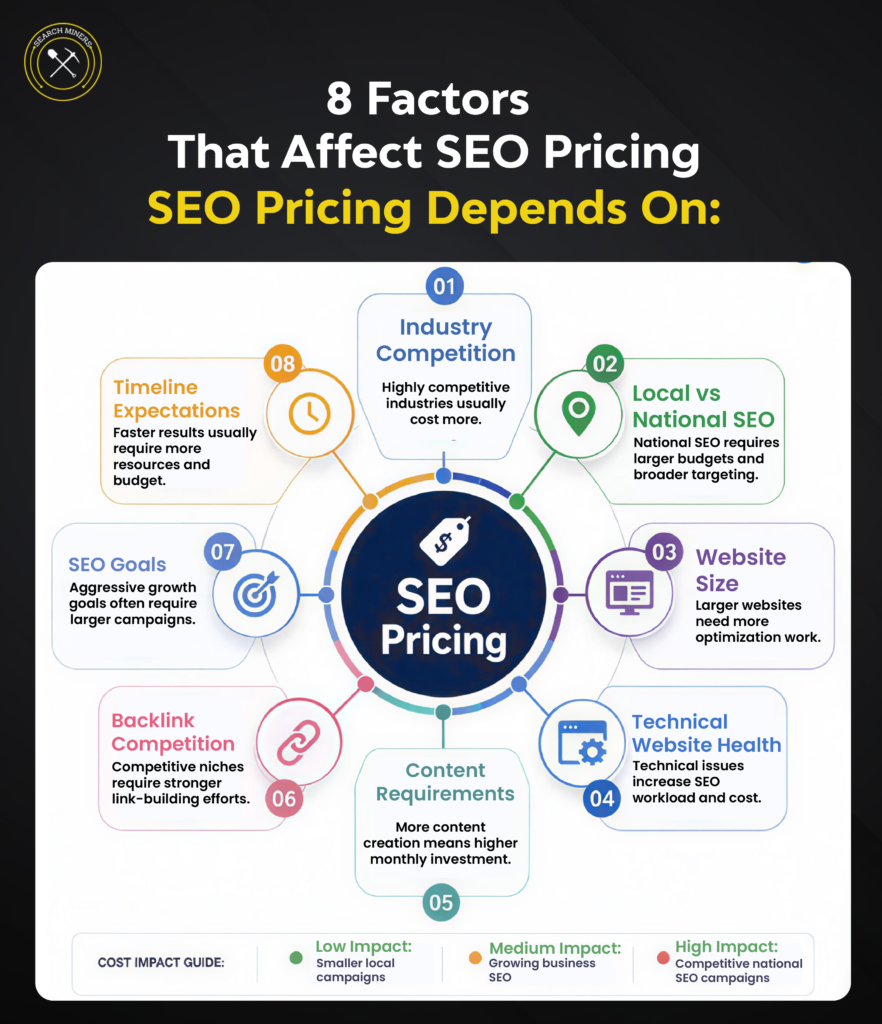
1- Industry Competition
Some industries are much harder to rank than others.
A personal injury law firm in New York is going up against hundreds of competitors who have been investing in SEO for years. A local bakery in a small city has almost no competition for the same keywords.
Tools like Ahrefs and SEMrush measure this with a keyword difficulty score. The higher the score, the more content, backlinks, and time it takes to outrank the competition.
Industries like legal, finance, and healthcare sit at the top of that scale. More competition means more work, and more work means higher cost.
2- Local vs National SEO
When someone nearby searches for what you offer, local SEO is what puts your business in front of them.
It comes down to a few key things:
- Keeping your Google Business Profile sharp
- Ensuring your name, address, and phone number are identical everywhere they appear online
- Getting listed in the right local directories
- Landing a spot in that coveted Google Maps Pack.
It won’t drain your budget, and you will typically start seeing traction quicker than with traditional SEO.
National SEO is a bigger project. You need to build authority across many keyword topics, earn backlinks from high-quality sites, and produce a lot more content.
The bigger the geographic target, the bigger the budget needs to be.
3. Website Size and Architecture
A 10-page local service site is simple to manage. A 500-page e-commerce store is not.
Bigger sites have more technical needs, including a larger crawl budget, an internal linking structure, schema markup, duplicate content issues, and regular monitoring in Google Search Console.
Every page needs to be optimized and kept healthy.
More pages mean more hours, and more hours mean a higher monthly cost.
4. Current Website Health
If your site has technical problems, SEO cannot fully work until they are fixed.
Google measures page experience through Core Web Vitals, three metrics called LCP (how fast your page loads), FID (how quickly it responds to clicks), and CLS (whether the page jumps around while loading).
According to Weblogic, sites that fail these Core Web Vitals tests rank 3.7 percentage points lower in search visibility on average than sites that pass them.
Broken links, slow load times, and poor mobile experience all need to be resolved first.
A site with many of these issues requires more upfront work, which increases your upfront cost.
5. Content Requirements
Google ranks content. And not just any content. It evaluates pages based on E-E-A-T, which stands for Experience, Expertise, Authoritativeness, and Trustworthiness.
Thin or generic pages do not score well against those signals.
The data backs this up.
Long-form content earns 77.2% more backlinks than short articles, which means better content also helps your link profile grow.
If your industry needs 20 well-researched articles to compete, those articles have to be written.
Agencies that include content creation charge more, but they also deliver more of what actually drives rankings.
6. Backlink Competition
Every time another website links to yours, that’s a backlink, and in Google’s eyes, it’s basically a vote of confidence.
The more of these quality votes your competitors have racked up, the tougher it becomes to climb past them in the rankings.
To put it in perspective, pages sitting at the top spot on Google have nearly 3.8 times more backlinks than those ranked just below them, and a staggering 95% of all pages on the web have none whatsoever.
Actually earning these links isn’t something you can shortcut. It takes genuine outreach, smart digital PR, and content good enough that other sites naturally want to reference it.
It’s easily one of the most labor-intensive parts of the entire SEO puzzle and a big reason you will notice such a wide gap in what different agencies charge.
7. SEO Goals
Ranking for one local keyword is a small project.
Building topical authority across dozens of content categories, showing up in Google AI Overviews, targeting featured snippets, or running SEO across multiple locations is a much larger one.
The bigger and more specific your goals, the more strategy, content, and link building it takes to get there.
Your goals set the scope, and the scope sets the price.
8. Timeline Expectations
SEO builds momentum over time.
If you want results in three months instead of twelve, more work has to happen at once: technical fixes, content, and link building all running in parallel from day one.
A realistic timeline lets your agency work at a sustainable pace and reduces overall costs.
Businesses that need fast results pay more to compress the timeline.
Is Your Website Ready for the AI Search Era?
Traditional SEO isn’t enough anymore. ChatGPT, Gemini, and AI Overview are changing how customers find businesses. Our GEO and semantic optimization strategies ensure you’re visible everywhere your customers are searching.
Stay ahead of the competition with cutting-edge optimization.
Real SEO Cost Examples for Small Businesses
A number on a pricing page means nothing without context.
After working with hundreds of small businesses at Search Miners, this is what each budget tier realistically delivers.
1- $500/Month SEO
At this budget, you are typically getting basic on-page optimization, keyword research, and minimal content updates.
Some freelancers will work at this rate, especially for simple local sites.
You should not expect aggressive link building or regular content creation. This is a starting point for very low-competition local businesses.
A one-location nail salon in a small Nevada town with almost no direct online competitors could see results at this budget over 6-9 months.
2- $1,500/Month SEO: Typical Local Campaign
At $1,500/month, you should expect keyword research, on-page optimization, Google Business Profile management, local citation building, monthly reporting, and at least one or two pieces of new content per month.
This is realistic for most local service businesses.
A plumbing company in Las Vegas targeting “emergency plumber Las Vegas” and similar terms. Results typically begin to show around month 4-6.
3- $3,000+/Month SEO: Competitive Growth
At $3,000/month and above, you are in growth-campaign territory.
This includes a full content strategy, consistent link building, technical SEO, conversion optimization, and regular competitor analysis.
If you’re in a competitive space or trying to reach customers across multiple areas, this is the budget range where things actually start moving.
A personal injury law firm in a major metro area or an e-commerce store trying to outrank national retailers in typical product categories.
4- Enterprise-Level SEO Budgets
For highly competitive national brands or large e-commerce sites, SEO budgets can run $5,000 to $15,000+ per month.
At this level, agencies are running full content operations, advanced technical audits, aggressive link acquisition, and integrated GEO and AI Overview optimization strategies.
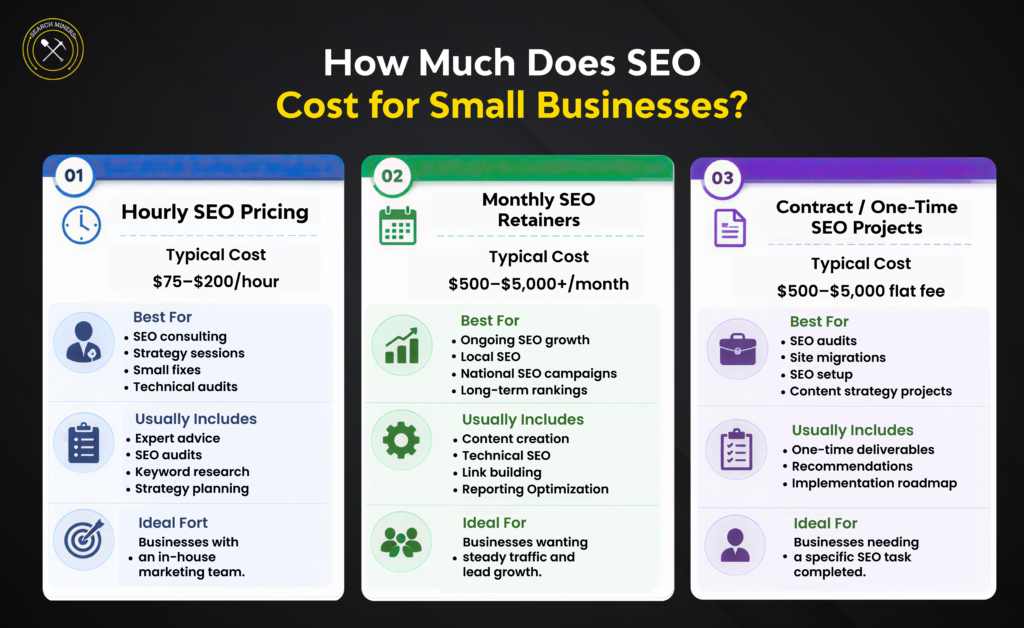
What are the SEO Pricing Models?
Not every business needs the same type of SEO engagement. This is how the pricing models break down, and which one fits where you are right now.
1- Monthly Retainers
Think of this as having an SEO team working in the background every single month.
You pay a fixed amount, and in return, the agency handles everything on an ongoing basis, including content strategy, content, technical fixes, link building, and reporting.
It is the most common model because SEO is not a one-time job.
Rankings take time to build and take consistent effort to hold. This model works best when both sides are aligned on long-term growth, not just quick wins.
2- Hourly SEO Consulting
You are not hiring someone to run your SEO. You are buying their brain for a few hours.
This works well when you already have a team that can execute, but need an expert to point them in the right direction.
Typical SEO consulting rates range from $75 to $200 per hour, depending on experience and specialization.
Good for a focused audit, a strategy session before launching a new site, or a second opinion on why your rankings dropped.
3- One-Time SEO Projects
Sometimes, you do not need an ongoing relationship; you need a specific thing done.
A technical audit. A site migration plan. A content strategy document your team can run with.
You pay once for a specific deliverable, which makes it a great fit for companies with a solid in-house team that simply want expert input before taking the wheel themselves.
4- Performance-Based SEO
This one sounds attractive on paper. You only pay when results happen. In practice, it is more complicated.
When an agency’s income depends on hitting ranking targets fast, the temptation to cut corners grows.
Risky link-building tactics and low-quality content can produce short-term gains that collapse later.
If you do go this route, make sure every deliverable, timeline, and success metric is spelled out in writing before work begins.
5- Local SEO Packages
These are purpose-built for businesses serving a specific city or region that do not need a national campaign.
A good local SEO package covers Google Business Profile setup and management, NAP citation building across local directories, locally targeted keyword optimization, and a review generation strategy.
Because the scope is narrower, these packages are usually more affordable than full-service retainers and for a local business, they are often exactly what is needed to show up where it counts.
If you are not sure whether you need a consultant or a full agency, a breakdown of SEO agency vs SEO consultant can help you decide.
Is Cheap SEO Worth It?
Cheap SEO is one of the most expensive mistakes a small business can make, not upfront, but over time.
This is what low-cost SEO usually delivers:
- Spam backlinks from irrelevant sites,
- Thin AI-generated content that says nothing useful
- Keyword stuffing that search engines now penalize,
- Outdated tactics from 2015
- Reports full of vanity metrics with no connection to actual revenue.
A Google penalty from bad link building can take 12-18 months to recover from.
By then, a competitor who invested in quality SEO has taken your rankings. The cost of recovering from a penalty almost always exceeds the money you saved by going cheap.
You cannot build that kind of authority with $200/month and spun content.
And if you are a Las Vegas business, these SEO mistakes Las Vegas businesses make are worth reading before you hire anyone.
Is Your Website Ready for the AI Search Era?
Traditional SEO isn’t enough anymore. ChatGPT, Gemini, and AI Overview are changing how customers find businesses. Our GEO and semantic optimization strategies ensure you’re visible everywhere your customers are searching.
Stay ahead of the competition with cutting-edge optimization.
How Long Does SEO Take to Show Results?
This is the question every small business owner asks, and the honest answer is: it depends on where you are starting from and how competitive your market is.
Realistic timelines actually look like this:
1- Local SEO Timeline
Most local businesses start seeing meaningful movement between months 3 and 6.
Google Business Profile improvements, citation cleanup, and on-page work often show results faster than content-driven campaigns.
2- National SEO Timeline
For national campaigns targeting competitive keywords, expect 6 to 12 months before major traffic growth.
Building topical authority and earning quality backlinks is not fast, but the compounding effect over time is significant.
3- Competitive Industry Timeline
In highly competitive niches like legal, finance, healthcare, or insurance, a 12–18-month timeline is realistic before rankings start to feel the impact of the investment.
The businesses that win are the ones that do not quit in month six.
If you are based in Nevada, take a closer look at how long SEO takes in Las Vegas specifically.
Is SEO Worth It for Small Businesses?
Yes, especially compared to paid advertising over time.
PPC gets you traffic the moment you pay. The second you stop paying, the traffic stops.
SEO builds an asset. Every article that ranks, every backlink you earn, every optimization you make keeps working for you even if you pause spending.
A business that builds strong organic rankings can significantly reduce its dependence on paid ads.
For local businesses, appearing in the Google Maps Pack for high-intent searches like “plumber near me” or “dentist in Las Vegas” drives calls and bookings with a direct, measurable ROI.
5 SEO Pricing Mistakes Small Businesses Make
Most small businesses do not lose money on SEO because SEO does not work. They lose it because of decisions made before the work even starts. These are the most common ones.
1- Choosing the Cheapest Agency
Price shopping for SEO the way you would for office supplies is a mistake. SEO is a skill-intensive service. Paying less usually means getting less, less time, less strategy, and fewer results.
2- Expecting Instant Rankings
Google has been clear that SEO takes time.
Any agency guaranteeing page one rankings in 30 days is either lying or planning to use tactics that will eventually hurt you.
3- Ignoring Content Quality
Search engines in 2026 are extremely good at identifying content that is thin, repetitive, or written for algorithms instead of people.
Low-quality content actively hurts your rankings.
4- Not Tracking ROI
If your SEO agency cannot show you how organic traffic connects to leads, calls, or revenue, that is a problem.
Track everything from keyword rankings to phone call volume.
5- Hiring Without Strategy
Tactics without a strategy are just noise.
Before any work starts, your SEO partner should be able to explain the plan, why it matters, and how it connects to your business goals.
How Can You Calculate Your SEO Budget?
Before you call a single agency, you should already have a rough budget in mind. A number based on your revenue goals, your customer value, and how competitive your market is.
This framework walks you through exactly how to get there.
- Set a revenue goal: how much new revenue do you want SEO to generate in 12 months?
- Know your customer value: what is the average lifetime value of a customer?
- Estimate your close rate: if SEO sends you 50 leads, how many do you close?
- Work backward: if one customer is worth $2,000 and you close 1 in 5 leads, you need 5 leads to generate $2,000. If you want $40,000 from SEO, you need roughly 100 leads.
- Match your budget to that goal: a $1,500/month SEO investment that generates 100 leads over a year is a 2x+ return.
Try the Search Miners Free SEO Cost Calculator!
Use our free SEO Cost Calculator to plug in your goals, competition level, and market size, and get a realistic budget estimate instantly.
Why Did SEO Prices Increase in 2026?
SEO costs more today than it did three years ago, and the reason is not inflation. It is the work itself getting harder.
AI-generated content flooded the web starting in 2023.
By 2025, Google had significantly tightened its quality standards to filter out thin, machine-made content. That means quality content that actually ranks takes more time from an expert to produce.
At the same time, AI Overviews in Google Search now appear above organic results for many queries.
To get featured in those, your content needs to be structured in specific ways, answer questions directly, and demonstrate real expertise.
That is a newer skill that not all agencies have developed yet.
Something else worth paying attention to is GEO, Generative Engine Optimization. The way people search is shifting.
A growing number of them are skipping the list of blue links entirely and just pulling answers straight from AI tools like ChatGPT, Perplexity, and Google’s own AI Mode.
Getting your brand mentioned in those responses isn’t the same game as traditional SEO. It demands a different approach to building authority, one that’s still evolving, but increasingly hard to ignore.
The cost of doing SEO right has gone up because the bar has gone up.
Rank Higher in Las Vegas Search Results
Get exclusive SEO insights, digital marketing strategies, and growth tips delivered straight to your inbox. Join business owners who are already using our expert advice to attract more customers and grow their revenue.
Ready to Find Out What SEO Will Cost for Your Business?
Every business is different. The best way to know your real SEO budget is to look at your goals, your competition, and your current website, not a generic pricing table.
Book a FREE appointment with Search Miners and get a custom SEO strategy from our Las Vegas-based team. We work with small businesses across the US and give you straight answers.
About Patrick Michaels
Patrick Michaels
Patrick brings 10+ years of SEO expertise and 15+ years of professional writing experience to the Search Miners team. He specializes in creating clear, actionable content strategies that drive real business growth.


![SEO Guarantee [Red Flags, Realistic Promises, & What to Ask]](https://www.searchminers.com/wp-content/uploads/2026/06/SEO-Guarantee-Red-Flags-Realistic-Promises-and-What-to-Ask-768x480.jpg)